Why does the lending world act like your investment strategy should hit a ceiling at four units just because you prefer short-term guests over long-term tenants? If you’ve tried to scale, you know the residential rules are designed to slow you down. Securing a 5-8 unit dscr with short term rental income is the ultimate power move for investors ready to graduate from single-family homes to high-yield multifamily assets.
We know the struggle. Traditional banks often refuse to count your STR revenue, and conventional lenders might disqualify you because your tax returns show the heavy write-offs that actually make your business profitable. It feels like you’re being punished for being a savvy entrepreneur. This 2026 scaling guide is your roadmap to securing high-leverage financing based on property performance, not your personal income. We’ll explore how to tap into commercial-lite debt, navigate the latest LTV limits, and use market projections to prove your property’s worth. It’s time to stop letting rigid institutional norms dictate the size of your portfolio.
Key Takeaways
- Break the four-unit barrier by shifting to commercial-lite financing designed specifically for the 5-8 unit multifamily “sweet spot.”
- Understand the specific DSCR math lenders use to verify short-term rental income and ensure your property meets the required coverage ratios.
- Identify the exact credit and reserve requirements needed to unlock the best leverage and rates for your 5-8 unit dscr with short term rental property.
- Scale your portfolio without the burden of personal income verification by focusing on property-level cash flow and professional rental projections.
Breaking the 4-Unit Barrier: Why 5-8 Unit STRs Need Specialized DSCR Financing
Many investors hit a glass ceiling after their fourth property. Why? Because that’s where the residential lending rulebook ends. Fannie Mae and Freddie Mac guidelines strictly define residential real estate as one to four units. Once you add a fifth door, you’ve officially entered the commercial arena. For short-term rental investors, the 5-8 unit range represents a lucrative “sweet spot.” It offers the economies of scale found in larger buildings without the massive management overhead of a 50-unit complex. You get more revenue-generating rooms under one roof, but traditional banks often aren’t equipped to help you cross that threshold.
The Limits of Traditional Residential Lending
Your local bank is likely stuck in a rigid underwriting mindset. They want to see W-2s, pay stubs, and pristine tax returns. If you’re a successful investor, your tax returns probably show significant write-offs to minimize your tax liability. In the eyes of a traditional underwriter, those smart deductions look like a lack of income. It’s a frustrating paradox: the more you grow your business, the harder it is to qualify for a conventional loan. Furthermore, traditional lenders usually ignore short-term rental income entirely, preferring the perceived safety of a one-year lease. A 5-8 unit dscr with short term rental strategy bridges this gap by focusing on what actually matters: the property’s earning power.
Defining the 5-8 Unit DSCR Loan
A 5-8 unit DSCR loan is an asset-based commercial-lite product that qualifies the property based on its ability to cover its own debt. Instead of scrutinizing your personal Debt-to-Income (DTI) ratio, lenders look at the Debt Service Coverage Ratio (DSCR) of the building itself. This is a “No-Doc” process. You won’t need to provide pay stubs or years of tax history to prove you can afford the mortgage. The property does the heavy lifting for you. This product is built specifically for the independent entrepreneur who values speed and flexibility over bureaucratic red tape. By prioritizing property cash flow over personal wealth metrics, you can scale your portfolio at a pace that traditional banking simply cannot match.
Think about the operational math. Managing eight individual single-family homes across town is a logistical headache. Managing eight units under one roof is a streamlined operation. You consolidate your maintenance, your cleaning crews, and your utilities. When you apply an STR strategy to this 5-8 unit category, the revenue often dwarfs what you would see from standard long-term leases. You aren’t just a landlord; you’re running a high-yield hospitality business that deserves a loan designed for your specific goals.
Calculating DSCR for Short-Term Rentals in 5-8 Unit Buildings
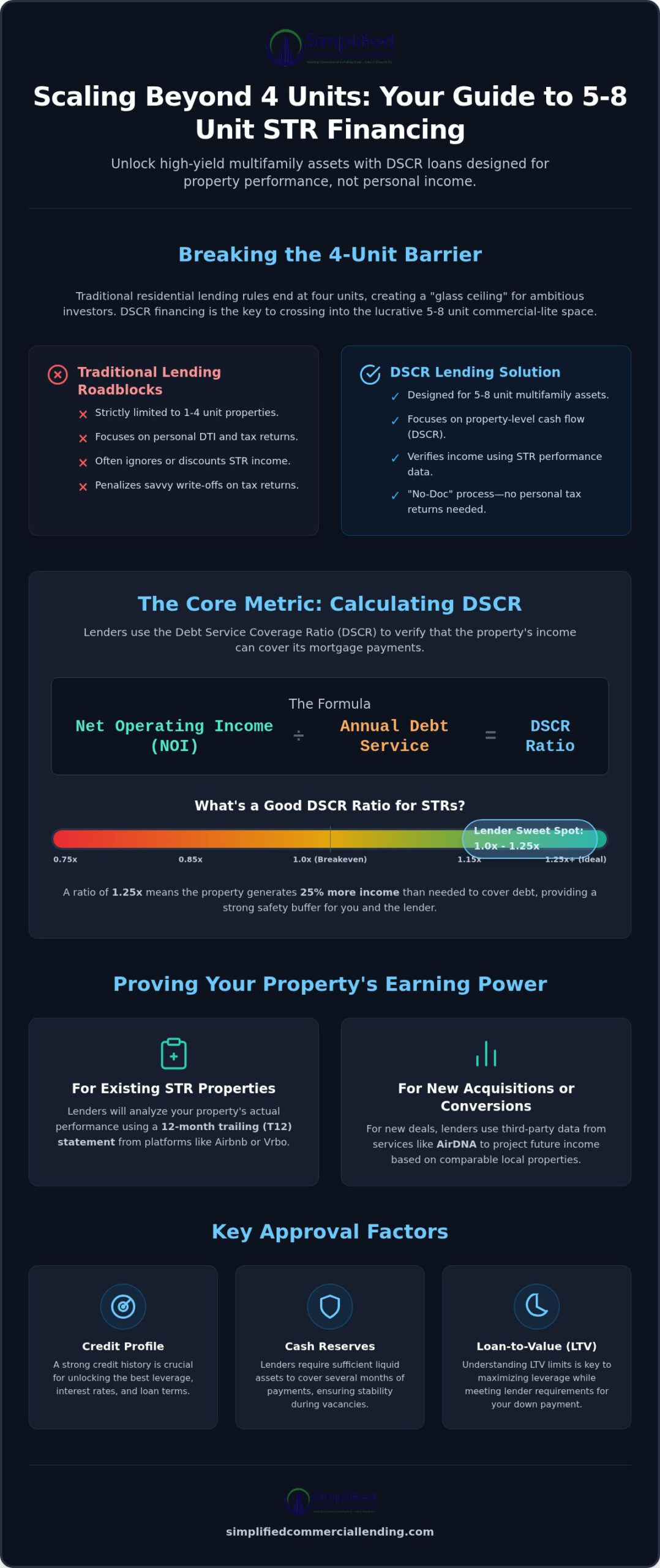
The math behind a 5-8 unit dscr with short term rental is the most critical part of your application. Unlike a standard residential loan that obsesses over your personal paycheck, this formula focuses entirely on the property’s performance. The basic equation is simple: Net Operating Income (NOI) divided by your annual debt service. While the Fannie Mae Small Loans program provides a baseline for small multifamily buildings, it often struggles to account for the dynamic nature of vacation rental income. DSCR lenders fill this gap by analyzing the property as a business rather than just a roof over someone’s head.
In a 5-8 unit building, your DSCR ratio often looks healthier than it would for a single-family home. This is because you’re spreading your risk across multiple units. If one unit is vacant for a week, you still have seven others generating cash. This inherent stability makes these properties highly attractive to commercial-lite lenders who prioritize consistent cash flow over personal credit depth.
AirDNA vs. Actuals: How Lenders Verify Income
Lenders need to see a track record or a very strong projection to get comfortable with the deal. If the building is already operating as an STR, you’ll provide a 12-month trailing (T12) statement showing actual revenue from platforms like Airbnb or Vrbo. For new acquisitions or conversions, we use third-party market data. Tools like AirDNA help us establish a projected income based on similar properties in the immediate area. Most successful investors aim for a coverage ratio between 1.0x and 1.25x. A 1.25x ratio means the property generates 25% more income than is required to pay the mortgage, providing a comfortable safety net for both you and the lender.
Operating Expenses in Small Multi-Family STRs
You can’t just look at gross revenue; the “Net” in Net Operating Income is what counts. Commercial-lite underwriting requires a realistic look at your expenses, including:
- Professional property management fees (typically higher for STRs than long-term rentals).
- Cleaning and turnover costs.
- Utilities, internet, and landscaping.
- Maintenance reserves for common areas.
While Zillow rent estimates focus on what a local resident pays for a 12-month commitment, STR ADR (Average Daily Rate) targets the premium price point travelers pay for a single night of convenience. Understanding this distinction is key to proving your property’s value. If you want to see how your projected ADR impacts your borrowing power, explore our specialized short term rental financing options to get a clear picture of your potential leverage.
5-8 Unit DSCR Loan Requirements: LTV, Reserves, and Credit Tiers
Scaling to a 5-8 unit dscr with short term rental requires a different set of keys than your standard residential duplex. Lenders view these as commercial assets, which means the underwriting focus shifts from your personal income to the property’s potential. For purchase loans in 2026, you can typically expect Loan-to-Value (LTV) ratios between 75% and 80%. If you’re looking for a cash-out refinance to fuel your next acquisition, expect a cap around 65% to 70%. Your credit score is the primary lever for these rates. While you can enter the arena with a 620 or 660, hitting a score of 720 or higher unlocks the most aggressive terms and lowest interest rates.
Lenders also look for an “Experience” factor. Managing eight units is a professional operation, so they prefer to see that you’ve managed similar assets before. However, the trade-off for these standards is incredible speed. The “No-Doc” nature of the loan means we aren’t waiting on IRS transcripts or endless pay stubs. Closing speed is where this product shines. While a traditional commercial loan might take 60 to 90 days, a DSCR loan can often close in 30 days or less. This speed allows you to compete with cash buyers in hot markets where these buildings are rare. Understanding the nuances of DSCR loan requirements for larger buildings helps you prepare your balance sheet before you ever sign a contract.
Liquidity and Reserve Requirements
This is where many investors trip up. For a 5-8 unit building, lenders typically require 6 to 12 months of PITIA (Principal, Interest, Taxes, Insurance, and Association dues) in liquid reserves. This ensures you can weather the seasonal shifts often highlighted in discussions about the economic impact of short-term rentals. You can use cash on hand, but most lenders also accept 401k or IRA balances, usually at a discounted percentage of their total value. Just remember; you generally cannot use the proceeds from a cash-out refinance to satisfy the reserve requirement for that same loan. You need to show that liquidity separately to prove the deal is stable.
1-4 Unit vs. 5-8 Unit DSCR Comparison
Moving to five units changes the appraisal game significantly. Expect a commercial appraisal process that takes longer and costs more than a residential one. These reports often include a detailed rent schedule analysis, which can add $200 to $500 to the standard fee because the appraiser must verify both long-term and short-term market rates. Prepayment penalties are also standard here. You’ll often see a “5-4-3-2-1” structure, where the penalty percentage decreases each year, though “3-2-1” options exist for those who want more flexibility to refinance sooner. Review our detailed breakdown of DSCR loan requirements to see how these tiers impact your specific scaling strategy.
Maximizing Leverage: How to Qualify Without Personal Tax Returns
Qualifying for a 5-8 unit dscr with short term rental doesn’t require a mountain of paperwork. It requires a strategic approach to property selection and entity structuring. Because these loans are asset-based, the lender cares about the building’s ability to generate cash, not your ability to prove a salary. This “No-Doc” approach is the secret weapon for investors who have high revenue but significant tax write-offs that would disqualify them at a traditional bank. To maximize your leverage and secure the best terms, follow this streamlined five-step process.
- Step 1: Identify a 5-8 unit property in a market with high short-term rental demand. Look for areas where hotel rates are high and vacation rentals are a preferred alternative.
- Step 2: Secure an STR-specific appraisal. Don’t rely on standard long-term rent estimates. Use tools like AirDNA’s ‘Rentalizer’ to provide the lender with data-backed revenue projections.
- Step 3: Structure your deal under an LLC. This protects your personal assets and aligns with the commercial-lite nature of 5-8 unit financing.
- Step 4: Partner with a specialized “No-Doc” lender. This allows you to bypass personal Debt-to-Income (DTI) checks and focus entirely on the property’s DSCR.
- Step 5: Close fast. Speed is your competitive advantage. While other investors are stuck in 90-day bank cycles, you can close in 30 days or less.
The Power of the LLC in Multi-Family Financing
Most lenders for 5-8 unit assets require you to take title in the name of an entity like an LLC or a Corporation. This isn’t just about liability protection. Borrowing as an entity simplifies the underwriting process because it clearly separates your personal life from the investment business. It allows the lender to treat the loan as a business-to-business transaction, which bypasses many of the rigid consumer protections that slow down residential mortgages. For a deeper dive into entity structuring, check out our commercial property loan guide to ensure your business is set up for maximum approval odds.
Bypassing the Debt-to-Income (DTI) Trap
Your personal car loan, student debt, or primary mortgage shouldn’t dictate your ability to buy an eight-unit apartment building. In the world of commercial-lite financing, your personal DTI is irrelevant. The property’s income is the only “paycheck” the lender verifies. This freedom allows you to scale without the arbitrary “income” limits imposed by conventional banks. If you need to access capital for your down payment, you can even use a portfolio line of credit for rentals to tap into the equity of your existing properties. This creates a self-funding loop that accelerates your portfolio growth. Ready to see how much leverage your property can support? Contact our expert team today to start your no-tax-return qualification process.
Scaling Your STR Portfolio with Simplified Commercial Lending
Traditional banks often treat independent investors like a risk. We treat you like a business owner. When you’re ready to secure a 5-8 unit dscr with short term rental, you need a partner who understands the high-velocity nature of the hospitality market. Simplified Commercial Lending acts as your expert guide, navigating the complex intersection of multifamily assets and vacation rental income. We don’t just offer loans; we offer a way to bypass the institutional bottlenecks that keep most investors stuck at four units. Our team knows that your success depends on speed and flexibility, not on how many tax write-offs you claimed last year.
The ‘Commercial-Lite’ Advantage
Why settle for a lending process designed for a suburban bungalow? Our “commercial-lite” approach is built for the speed of the 2026 market. We prioritize your property’s cash flow over your personal tax returns. This streamlined process is designed specifically for 5-8 unit residential assets that fall into the gap between standard residential and heavy institutional commercial debt. We advocate for the independent entrepreneur by providing a “No-Doc” experience that wins in competitive bidding wars. When you don’t have to wait for months of bank underwriting, you can move with the confidence of a cash buyer.
Managing 5-8 units requires a deep understanding of short term rental financing. We know how to present your AirDNA data or T12 statements to ensure the highest possible leverage. We understand that your income isn’t a steady paycheck; it’s a dynamic revenue stream that consistently outperforms long-term leases. Our goal is to help you unlock that equity and keep your momentum moving forward without the friction of traditional banking.
Ready to Add More Doors?
Preparation is the key to a fast close. Before you even sign a contract on your next building, let’s look at your current scenario. We offer a preliminary review without a hard credit pull. This gives you a clear picture of your borrowing power and allowed LTVs before you commit. To prepare for your first 5-8 unit STR deal, gather your LLC documents and any existing property performance reports. We handle the heavy lifting from there.
Stop letting rigid banking protocols slow your growth. Scale your portfolio today with a lender that values results over red tape. Get a quote for your 5-8 unit deal now and see how simple scaling can actually be.
Take Control of Your Multifamily Future
Scaling past the four-unit limit is more than just a property count increase; it’s a structural shift into professional investing. By utilizing commercial-lite debt, you bypass the restrictive W-2 requirements that hold most investors back. You’ve learned how to leverage market data for income verification and why the 5-8 unit range is the ultimate sweet spot for high-yield hospitality. Securing a 5-8 unit dscr with short term rental income is the fastest path to building a resilient, high-cash-flow portfolio in 2026.
Simplified Commercial Lending is your national partner for this journey. We specialize in No-Doc commercial lending and offer specialized programs designed specifically for multifamily STR assets. We eliminate industry bottlenecks so you can focus on finding the next deal. Don’t let your tax returns dictate your growth potential any longer. The tools for rapid expansion are ready when you are.
Scale your portfolio without tax returns; Get a 5-8 unit quote today
Your vision for a professional portfolio is attainable. Take the next step and start your acquisition journey with confidence.
Frequently Asked Questions
Can I get a DSCR loan for a 5-8 unit property if it’s my first investment?
Yes, but it depends on the specific lender’s appetite for risk. While many 5-8 unit programs prefer at least one year of investment property management experience, some “No-Doc” options exist for first-time buyers with strong liquidity and credit scores above 700. Expect a slightly lower Loan-to-Value (LTV) ratio, typically around 65% to 70%, to offset the lack of a track record.
Do lenders use AirDNA for 5-8 unit short-term rental income projections?
Lenders frequently use AirDNA’s ‘Rentalizer’ or similar third-party market data to establish projected income for a 5-8 unit dscr with short term rental property. This is especially true for new acquisitions where a 12-month trailing history isn’t available. Lenders typically apply a “haircut” of 20% to 30% to these projections to account for market fluctuations, ensuring the property maintains a healthy coverage ratio even in slower seasons.
What is the minimum FICO score for a 5-8 unit DSCR loan?
The minimum FICO score generally ranges between 620 and 660 for most commercial-lite programs. However, to unlock the most competitive interest rates and higher leverage, you should aim for a score of 720 or higher. A lower credit score often results in a higher interest rate and may require a larger down payment, as lenders use your credit history as a secondary layer of security for the asset-based loan.
Is a 5-8 unit building considered residential or commercial for financing?
A 5-8 unit building is classified as commercial property for financing purposes. Because traditional residential guidelines from Fannie Mae and Freddie Mac stop at four units, these larger buildings require specialized multi-family residential investment loans. This classification is actually a benefit for savvy investors. It allows you to use asset-based underwriting that focuses on the building’s Net Operating Income rather than your personal debt-to-income ratio or tax returns.
How much down payment is required for a 5-8 unit STR DSCR loan?
You should typically prepare for a down payment of 20% to 25% for a 5-8 unit purchase. While some specialized programs offer up to 80% Loan-to-Value (LTV) for well-qualified borrowers, a 25% down payment is the industry standard for short-term rental assets. This equity stake provides the lender with a safety margin, ensuring the property can still cover its debt service if the local vacation rental market experiences a temporary downturn.
Can I use a DSCR loan for a mixed-use property with 5-8 units?
Yes, you can often use a DSCR loan for mixed-use properties, provided the residential portion makes up at least 50% to 80% of the total square footage or income. Lenders will analyze both the short-term rental revenue from the apartments and the commercial lease income from any ground-floor retail space. This hybrid approach requires a lender with expertise in commercial property loans who understands how to balance multiple income streams.
Are there prepayment penalties on 5-8 unit multi-family loans?
Prepayment penalties are standard for almost all 5-8 unit DSCR programs. You will commonly see a “5-4-3-2-1” structure, meaning the penalty starts at 5% in the first year and decreases annually. Some lenders offer shorter “3-2-1” options or even “no-penalty” structures in exchange for a slightly higher interest rate. These penalties protect the lender’s yield on the loan while providing you with a predictable path toward future refinancing.
Do I need to show my personal tax returns for a 5-8 unit DSCR loan?
No, you don’t need to provide personal tax returns for our specialized 5-8 unit dscr with short term rental programs. We prioritize property cash flow and Net Operating Income over your personal income history. This “No-Doc” approach is perfect for entrepreneurs who have heavy tax write-offs that might disqualify them for traditional bank financing. Instead of looking at your 1040s, we focus on the property’s ability to generate revenue and cover its own debt.