Why are you still letting a debt-to-income ratio dictated by a big bank stop your portfolio from growing? It’s a common trap for independent investors who want to refinance single family investment property but hit a wall of bureaucratic paperwork. You have high-performing rentals and significant equity. However, traditional lenders often treat your self-employment or complex tax returns like a liability. We get it. It’s frustrating to watch your expansion stall because a bank’s rigid checklist ignores your actual success.
Stop jumping through hoops and start using your assets effectively. You can bypass traditional banking red tape by focusing on what actually matters: your property’s cash flow. This guide will show you how to use your rental’s income to secure better terms or cash-out for your next acquisition. We’ll explore how DSCR loans work in the 2026 market, explain current LTV limits, and show you how to turn your existing equity into a powerful tool for scaling your portfolio.
Key Takeaways
- Learn how to refinance single family investment property using rental income rather than personal tax returns to unlock equity for your next deal.
- Compare DSCR loans against traditional banking models to see how cash-flow-based underwriting accelerates your path to closing.
- Identify the key credit score and loan-to-value requirements you need to secure competitive 2026 rates for rental properties.
- Master a simplified five-step refinancing process that removes the typical paperwork hurdles faced by self-employed investors.
- Discover how to use portfolio lines of credit to cross-collateralize your assets and scale your real estate business beyond a single home.
Why Refinance a Single Family Investment Property in 2026?
Stop viewing your rental property as just a monthly check. In 2026, successful investors view their properties as dynamic capital reserves rather than static buildings. When you choose to refinance single family investment property, you aren’t just changing a loan; you’re repositioning your business for the next acquisition. Equity is the engine of growth. If that equity is sitting “dead” in a house, it isn’t working for you. You have to put it to work.
Understanding what is refinancing helps you distinguish between two main strategic paths. A rate-and-term refinance focuses on improving your monthly bottom line by securing a better interest rate or adjusting the loan duration. A cash-out refinance allows you to pull liquidity directly from the property’s value. With national 30-year fixed rates for investors starting around 7.27% in August 2026, the strategy shifts from chasing the lowest rate to accessing capital for higher-yield opportunities. It’s about liquidity, not just interest points.
The Core Benefits for Real Estate Entrepreneurs
Refinancing serves as a tactical tool to optimize your portfolio’s performance. First, it can significantly improve your monthly cash flow. By extending your loan term or lowering your rate, you keep more profit in your pocket every month. Second, it lets you unlock equity to fund down payments on new properties. This is how you scale without needing a massive personal savings account. Finally, it’s an excellent way to consolidate high-interest bridge debt or short-term loans into stable, long-term permanent financing. You gain predictability and lower your overall risk profile.
When is the Right Time to Refinance?
Timing isn’t just about the calendar; it’s about the numbers. You should look at the break-even point, which is how long it takes for your monthly savings to cover the closing costs. If you plan to hold the property longer than that window, it’s a win. Another trigger is reaching key LTV milestones. For instance, most lenders for a refinance single family investment property require you to maintain 20% to 25% equity. If your property value has increased through market appreciation or a value-add project, you can recapture that capital. This is the heart of the BRRRR method. You renovate, increase the value, and then refinance to pull your initial investment back out for the next deal. Don’t wait for rates to drop to historic lows if the equity you’re sitting on could be buying your next three-unit building today.
DSCR vs. Traditional Refinancing: Which Path is Faster?
Speed is the most valuable currency in real estate. If a prime deal hits the market, you need liquidity immediately; not in 60 days. Most investors start their journey with traditional banks because it’s familiar. However, when you try to refinance single family investment property at a high-street bank, you’re entering a marathon of paperwork. Traditional lenders focus on you as a person. They want to see your W2s, your personal debt, and your tax returns. This model is built for homeowners, not entrepreneurs.
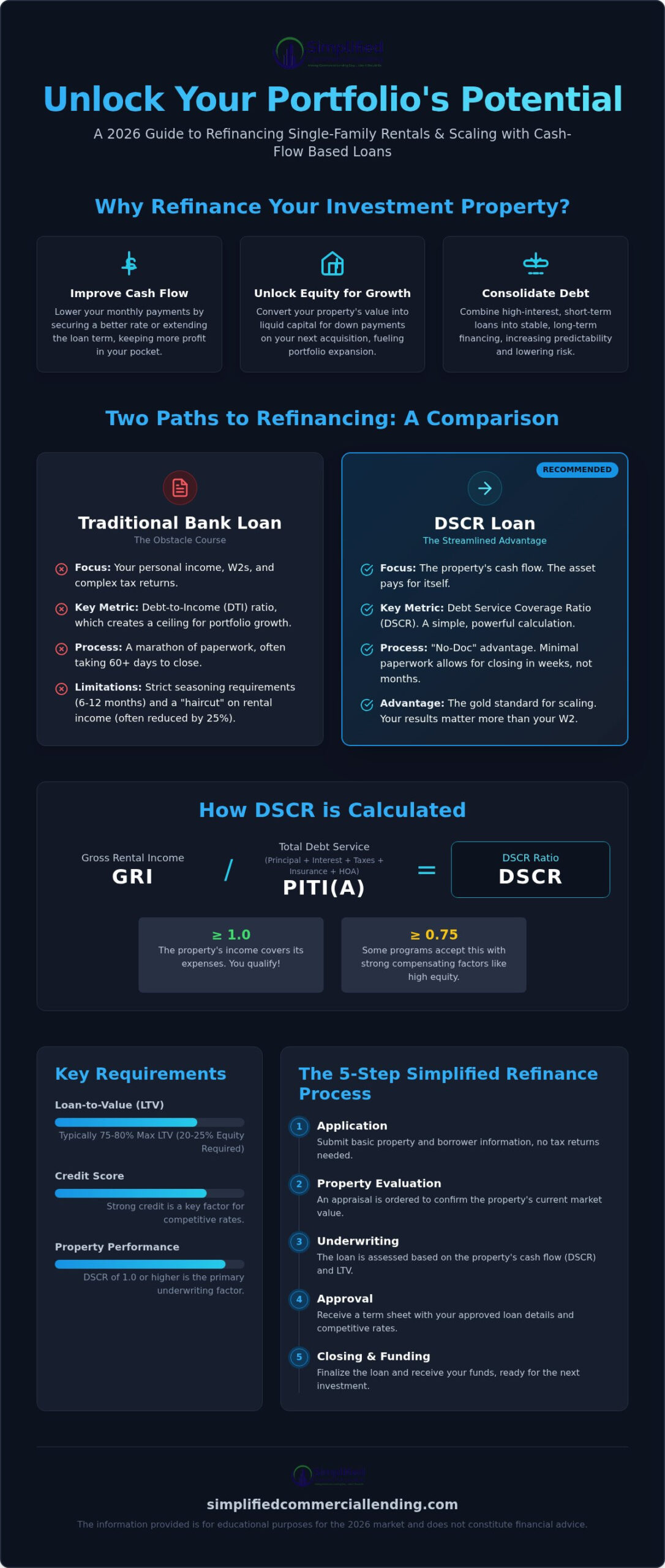
DSCR loans represent a “Simplified” cash-flow model. Instead of scrutinizing your personal income, these loans focus on the property’s ability to pay for itself. This shift in perspective removes the biggest bottleneck in the industry: you. By removing personal income verification, the process moves at a fraction of the time. Closing can happen in weeks, not months. It’s a disruptive approach that prioritizes your results over your paperwork.
The Traditional Bank Obstacle Course
Traditional banks rely heavily on Debt-to-Income (DTI) ratios. This works fine for your first rental. But what happens when you reach your fourth or fifth property? Your DTI often hits a ceiling. Even if your rentals are profitable, a bank’s rigid formula might see you as “over-leveraged.” They also impose strict seasoning requirements; they often force you to wait six to twelve months before you can touch your equity. They view rental income with skepticism, often applying a “haircut” that reduces the perceived value of your cash flow by 25% or more. It’s a system designed to slow you down.
The DSCR Advantage for Scaling
Debt Service Coverage Ratio (DSCR) loans are the gold standard for scaling. The calculation is straightforward: divide the property’s gross rental income by the total debt service (principal, interest, taxes, insurance, and HOA). If the ratio is 1.0 or higher, the property qualifies. Some programs even allow for a ratio as low as 0.75 if the equity is strong. This is a “No-Doc” advantage. You don’t need to provide pay stubs or tax returns. The property’s performance is the primary underwriter. For a deep dive into the technical specs, check out our DSCR Loan Requirements guide. If you want to see how these terms apply to your current portfolio, you can start a conversation at Simplified Commercial Lending today.
Key Requirements for Single Family Rental Refinancing
Getting ready to refinance single family investment property requires a shift in focus. You aren’t proving your worth as a borrower in the traditional sense; you’re proving the property’s worth as an asset. While big banks demand perfection across your personal life, specialized investment products look for specific performance markers. You need to hit these benchmarks to unlock the best terms in 2026.
- Credit Score: A score between 660 and 680 is the “sweet spot.” It provides the best balance of leverage and interest rate for most DSCR products.
- Loan-to-Value (LTV): For a cash-out refinance on a single-unit property, expect a maximum LTV of 75%. If you’re doing a rate-and-term refinance, you might push that to 80%.
- Property Type: These programs are designed for 1-4 unit residential properties. Ensure your property is zoned correctly before you apply.
- Liquidity Reserves: You’ll need to show 2 to 12 months of principal, interest, taxes, and insurance (PITI) in the bank. This proves you can handle a temporary vacancy.
Don’t let these numbers intimidate you. Unlike traditional mortgages, your personal debt-to-income ratio doesn’t dictate the outcome here. If the property’s income covers the new mortgage payment, you’re in a strong position. Focus on the asset’s performance, and the financing will follow.
Appraisal and Rent Verification
The appraisal for an investment property is different from a standard home valuation. You need a Form 1007 Rent Schedule. This document verifies the fair market rent for your property in its current market. Since your DSCR calculation relies on this number, accuracy is vital. Make sure the property is in good condition. Even for “as-is” loans, visible neglect can lower the appraised value and shrink your available equity. Manage the process by providing the appraiser with a list of recent upgrades and current lease agreements to ensure your equity is fully recognized.
Title and Insurance Basics
Flexibility is key for scaling. Most savvy real estate entrepreneurs hold their properties in an LLC. This protects personal assets and makes it easier to manage a growing portfolio. Ensure your title is clean before you start the process. Any existing liens or “clouds” will stall your closing. You also need the right insurance. Standard homeowner policies won’t cut it. You need a DP3 (Landlord) policy. These are designed specifically for non-owner-occupied rentals and cover the unique risks associated with tenants. Clear these hurdles early to keep your momentum high.
The 5-Step Simplified Refinance Process
Traditional banks often drag their feet for 45 to 60 days. For an active investor, that’s an eternity. Our streamlined approach focuses on efficiency and removes the hurdles that typically stall your progress. When you decide to refinance single family investment property through specialized channels, you’re choosing a path designed for speed and clarity. We’ve stripped away the unnecessary layers to get you to the closing table faster.
Step 1: Initial Consultation and Strategy Session. We start by identifying your primary objective. Are you looking to lower your monthly payment to improve cash flow, or do you need to pull cash out for your next down payment? Defining this early ensures we pick the right loan product for your specific goal.
Step 2: Submit Basic Property Information. You can leave the mountain of personal tax returns behind. We focus on the property’s data. You’ll provide basic details about the asset, its current value, and its rental income. This “no-doc” approach is what allows us to move while others are still digging through filing cabinets.
Step 3: Processing and Appraisal. Once the initial data is in, we order the appraisal. As we mentioned earlier, the appraiser will complete a rent schedule to verify the market rate. This is where your property’s cash flow does the talking. We handle the heavy lifting of processing the file in the background.
Step 4: Underwriting Approval. We fast-track your file through non-bank channels. Because we aren’t bound by the same rigid regulations as retail banks, our underwriters focus on the asset’s performance. This results in a much smoother approval process with fewer “conditions” to clear.
Step 5: Closing and Funding. After approval, we move straight to closing. You’ll sign your documents, and the funds are distributed. Whether you’re securing a new rate or receiving a wire for a cash-out, you’ll have your capital in record time.
Gathering Your “Simplified” Document Package
Even a simplified process requires some paperwork, but it’s focused entirely on the business side of your investment. You don’t need to prove your personal income; you need to prove the property’s performance. Have these items ready to keep the momentum high:
- Current lease agreements and a 12-month history of on-time payments.
- Property management reports if you use a third-party service.
- LLC organizational documents, including your Operating Agreement and EIN.
Closing Day: What to Expect
The final day is straightforward. You’ll sign the promissory note and the deed of trust with a mobile notary or at a title office. In some cash-out scenarios, there may be a 3-day right of rescission, though this is less common for business-purpose investment loans. Once the rescission period ends or the file is recorded, the title company initiates the wire transfer. You’ll see the cash-out funds in your business account shortly after. If you’re ready to unlock your equity, start your refinance application today.
Scaling Your Portfolio: Beyond the Single Property
Refinancing a single home is a great start. But real wealth is built when you stop treating your properties as isolated islands. If you own multiple rentals, you can bundle them into a single “Blanket Loan.” This allows you to cross-collateralize your assets, using the combined equity of several houses to secure a much larger pool of capital. When you refinance single family investment property at this level, you aren’t just managing debt; you’re building a financial infrastructure.
Many investors use a portfolio line of credit for rentals to maintain constant liquidity. This tool gives you the power to act fast when a new opportunity appears. It’s also an essential exit strategy for those using hard money. You can use single family residential investment loans to pay off high-interest private lenders and move into stable, long-term debt. This move protects your margins and secures your cash flow for the next decade.
The Velocity of Money Strategy
Success in real estate depends on how fast you can recycle your capital. This is the “Velocity of Money.” By using a cash-out refinance, you pull your initial down payment back out of a property once it has appreciated or been renovated. You then use those same funds to buy your next asset. This cycle allows you to grow a massive portfolio with a finite amount of seed money. You just have to balance your leverage. Always keep a safety margin in your cash flow to handle maintenance or vacancies. If your property’s DSCR remains healthy, you can keep the engine running indefinitely.
Working with a Commercial Broker Partner
Why choose a broker over a local bank? A bank only has one set of rules and one “vault” of money. If you don’t fit their box, you’re stuck. A commercial broker acts as your navigator. We have access to “off-market” debt products that retail banks don’t offer to the general public. This includes specialized lenders who understand the needs of multi-property owners. We don’t just look at your next deal. We help you build a 10-year growth plan. By establishing a long-term relationship, you ensure that you always have a reliable source of capital, no matter how much the traditional banking landscape shifts.
Take Control of Your Portfolio’s Growth
Your investment properties are more than just monthly rent checks; they’re your most powerful capital reserves. By choosing to refinance single family investment property through a cash-flow-based model, you remove the personal income hurdles that stall most investors. You’ve seen how DSCR loans prioritize property performance over your personal tax returns. This shift gives you the speed and flexibility needed to scale a portfolio in today’s competitive market. Whether you’re consolidating debt or pulling cash for a new down payment, the power is in your hands.
We provide national coverage for all US investors with a focus on results, not red tape. Our underwriting is based on property cash flow, which means no tax returns are required to qualify. Don’t let traditional banking bureaucracy slow your momentum. It’s time to move your capital and expand your reach. Bypass the bank red tape and see your refinance options today. Your next big move is waiting for you to unlock the capital you’ve already earned.
Frequently Asked Questions
Can I refinance a rental property with no tax returns?
Yes, you can refinance without showing personal tax returns by using a Debt Service Coverage Ratio (DSCR) loan. These products focus on the property’s gross rental income rather than your personal W2 or 1099 earnings. This is ideal for self-employed investors who have significant write-offs that lower their taxable income. The lender simply verifies that the property’s cash flow covers the debt service, allowing you to bypass traditional banking red tape.
What is the maximum LTV for a cash-out refinance on a single-family investment property?
The maximum Loan-to-Value (LTV) for a cash-out refinance on a single-unit investment property is typically 75% in 2026. For two- to four-unit properties, the limit generally drops to 70%. If you’re performing a rate-and-term refinance instead of pulling cash out, you might secure an LTV as high as 80%. These limits ensure you maintain a sufficient equity cushion to protect both your investment and the lender’s interest.
How much equity do I need to refinance my rental property?
You generally need at least 20% to 25% equity to refinance single family investment property. Lenders typically require you to leave a portion of your equity in the deal to mitigate risk. For cash-out transactions, most investors find they need around 25% equity to qualify for the most competitive rates. If your property has appreciated significantly since purchase, you can leverage that new value to access capital for your next acquisition.
Is it harder to refinance an investment property than a primary residence?
Refinancing an investment property is technically stricter than a primary residence but can be functionally easier with the right loan product. Traditional banks require higher credit scores and larger cash reserves for rentals. However, choosing a DSCR loan removes the debt-to-income (DTI) hurdle that often blocks growth for primary homeowners. While the interest rates are slightly higher, the removal of personal income verification makes the overall process much faster and less intrusive.
Can I use a DSCR loan to refinance my single-family rental?
Yes, a DSCR loan is often the best tool to refinance single family investment property for active investors. These loans are specifically designed to help you scale your portfolio without the documentation burden of a conventional mortgage. Underwriting is based on the property’s ability to pay for itself. If the rental income covers the mortgage, taxes, and insurance, the property qualifies. It’s a streamlined path that prioritizes your results over your paperwork.
What are the closing costs for an investment property refinance?
Closing costs for an investment refinance typically range from 2% to 5% of the total loan amount. These costs include appraisal fees, title insurance, and loan origination fees. You also need to account for the cost of a Form 1007 Rent Schedule, which is required to verify market rents. While these costs are a factor, many investors roll them into the new loan balance to keep their out-of-pocket expenses as low as possible.
How long do I have to own a property before I can refinance it?
Most traditional lenders require a seasoning period of six to twelve months before you can refinance based on a new appraised value. However, specialized commercial products may offer more flexibility. If you’ve completed a significant value-add project, some lenders allow you to refinance sooner to recapture your renovation capital. Always check the specific seasoning requirements of your loan program to ensure your timing aligns with your growth strategy.
Can I refinance multiple rental properties into one loan?
You can absolutely consolidate multiple rental properties into a single loan using a Blanket Loan or a Portfolio Line of Credit. This strategy allows you to cross-collateralize your assets, often resulting in lower overall management costs and a single monthly payment. It’s a powerful way to simplify your finances while unlocking equity across your entire portfolio. This approach is specifically designed for investors who’ve outgrown the single-property financing model.