Why are you still letting your personal tax returns dictate the growth of your commercial portfolio? If you’ve been rejected by a traditional bank because of your debt-to-income ratio or a complex tax situation, you know how frustrating the status quo can be. Traditional lenders often miss the bigger picture. They obsess over your personal income instead of the revenue potential of the asset itself. It’s a slow, invasive process that stops many investors from scaling past their first few properties. Fortunately, commercial real estate cash flow loans offer a disruptive alternative that prioritizes property performance over your personal financial history.
We understand that in 2026, speed and flexibility are your greatest competitive advantages. You need a way to close deals without the mountain of paperwork or the scrutiny of your private tax data. This guide shows you exactly how to secure financing based on a property’s Debt Service Coverage Ratio (DSCR). You’ll discover how to protect your privacy, access flexible capital, and finally build the rental portfolio you’ve envisioned. We’ll show you how to stop jumping through hoops and start closing deals based on real-world income.
Key Takeaways
- Learn why asset-based underwriting is replacing personal income verification as the primary scaling tool for investors in 2026.
- Discover how commercial real estate cash flow loans allow you to qualify based on property income rather than restrictive debt-to-income ratios.
- Master the Debt Service Coverage Ratio (DSCR) to unlock capital without sharing years of private tax records or invasive documentation.
- Compare the speed of cash flow lending against traditional mortgages to ensure you can close deals in weeks instead of months.
- Find out how to leverage existing equity and portfolio lines of credit to expand your rental business without hitting a bank’s property limit.
Beyond Tax Returns: The Shift Toward Cash Flow Lending in 2026
The lending landscape has fundamentally changed. In 2026, savvy investors have moved away from the rigid, slow-moving requirements of traditional institutions. Why? Because big banks still treat high-net-worth real estate professionals like standard W-2 employees. This creates a massive bottleneck for anyone trying to scale. A cash flow loan flips the script; it focuses on the revenue your property generates rather than the numbers on your personal 1040 forms.
Traditional full-doc lending was designed for a different era. But 2026 market volatility has proven that personal income is often a secondary metric. The real value lies in the asset itself. Non-bank commercial lenders have stepped into this gap, offering speed and flexibility that traditional banks simply cannot match. They prioritize property performance over your personal financial history, making it easier to move when a deal hits your desk.
Why Traditional Banks Fail Real Estate Investors
The most common hurdle is the ‘Tax Return Trap.’ You use legal deductions and depreciation to minimize your tax liability. That’s smart business. However, a traditional bank sees those same deductions as a lack of income. They use rigid Debt-to-Income (DTI) ratios that completely ignore the actual potential of your commercial property. If your personal income doesn’t meet their narrow criteria, you get a rejection letter. It doesn’t matter if the property brings in thousands in net profit every month.
Beyond the paperwork, institutional approval cycles are notoriously slow. In a competitive market, waiting months for a loan committee to meet means you’ve already lost the deal to a faster investor. You need capital that moves at the speed of the market, not the speed of a bank’s bureaucracy.
The Rise of Asset-Based Financing
Asset-based financing removes the individual from the center of the equation. By using commercial real estate cash flow loans, you shift the underwriter’s focus to where it belongs: the property’s performance. Does the rent cover the mortgage, taxes, and insurance? If the answer is yes, you have a viable deal. This shift is why these loans are the preferred tool for scaling a portfolio quickly. You aren’t limited by how many properties you can carry on your personal credit report.
Private capital offers a level of flexibility that government-backed loans or traditional mortgages can’t touch. You get faster closing times that allow you to act on off-market opportunities. You also gain freedom from the intrusive scrutiny of your personal financial history. In 2026, commercial real estate cash flow loans ensure the property is the borrower. Your job is simply to find assets that perform and let the cash flow do the talking.
Understanding Commercial Real Estate Cash Flow Loans (DSCR)
A commercial cash flow loan is a specialized financial tool where the property’s income potential, rather than your personal salary, secures the financing. In 2026, these loans have become the gold standard for investors who want to scale without hitting the lending wall of traditional banks. By using commercial real estate cash flow loans, you treat your real estate as a self-sustaining business. The lender cares about one thing: Does this property generate enough revenue to pay its own bills? If it does, you’re in business.
How the DSCR Calculation Works
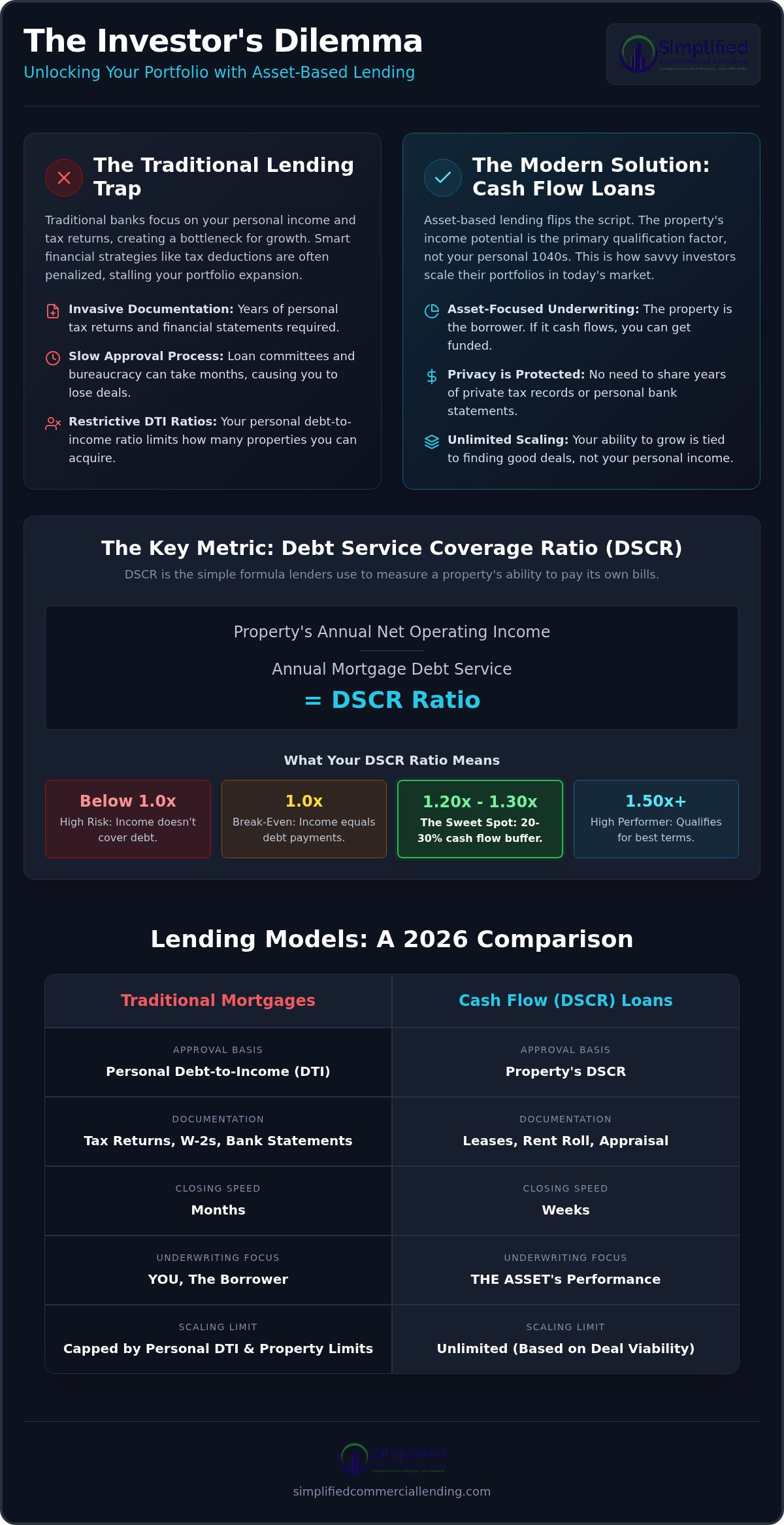
Lenders look at one primary number to determine your eligibility: the Debt Service Coverage Ratio (DSCR). Debt Service Coverage Ratio is the ratio of a property’s annual net operating income to its annual mortgage debt service. It’s a simple way to measure risk and ensure the asset can handle its own debt obligations without needing a subsidy from your personal bank account.
What do these ratios mean for your loan approval? A 1.00x ratio means the property breaks even. Most lenders in 2026 look for a “sweet spot” between 1.20x and 1.30x, which provides a 20% to 30% safety cushion. If your property hits a 1.50x ratio, you have a high-performing asset that likely qualifies for the most competitive terms available. This math provides a clear, objective path to funding that doesn’t involve digging through your personal tax history.
Property Types That Thrive on Cash Flow Financing
This lending model works across a wide range of income-producing assets. Multi-family residential properties with five or more units are the most common candidates. These assets offer stable, predictable revenue that underwriters love. Retail centers, strip malls, and mixed-use investment properties also qualify easily because their commercial leases provide documented, long-term cash flow.
In 2026, we’ve also seen a massive surge in short-term rentals and industrial warehouses using this model. Distribution centers with strong tenants are perfect for commercial real estate cash flow loans because the lease agreement itself proves the property’s ability to service debt. Whether you’re managing a vacation rental portfolio or a block of warehouses, the focus remains on the asset’s performance. Hospitality assets are no exception — investors pursuing hotel financing for investors can use the same DSCR-based approach to secure capital based on RevPAR and operational cash flow rather than personal income. If you want to see how this works for your specific assets, you can learn more about a portfolio line of credit for rentals to keep your momentum going.
Why do 2026 investors prioritize these metrics over equity growth? In a fluctuating market, appreciation is a bonus, but cash flow is a necessity. It provides the immediate liquidity needed to cover expenses and fund your next acquisition. Cash flow lending gives you the freedom to grow your portfolio based on your ability to find great deals, not your ability to show a high personal income on a tax return.
Cash Flow Loans vs. Conventional Mortgages: A 2026 Comparison
Choosing between a conventional mortgage and a cash flow loan isn’t just about the interest rate. It’s about how quickly you can move. In the 2026 market, conventional banks still move at a glacial pace. They require months of underwriting and years of personal financial history. If you’re chasing a high-demand multi-family asset, you don’t have months. You have weeks. Commercial real estate cash flow loans provide the agility needed to outmaneuver competitors who are still stuck in the bank’s lobby.
The differences go beyond speed. Conventional lenders often demand 20% to 25% down while strictly limiting your borrower entity options. Cash flow lenders are far more flexible with LLCs and Corporations. This allows you to protect your personal assets while scaling your business. In 2026, LTV expectations for asset-based loans typically hover around 70% to 75%, providing a solid balance of leverage and safety without the invasive scrutiny of a traditional bank.
The ‘No-Doc’ Advantage for Investors
Privacy is a luxury that traditional banks don’t offer. When you apply for a conventional mortgage, you hand over every detail of your financial life. This includes years of tax returns, bank statements, and W2s. For many investors, this level of scrutiny is a dealbreaker. It’s not just about the paperwork; it’s about the “Tax Return Trap” we discussed earlier. If your legal deductions are high, your on-paper income looks low to a traditional underwriter.
A no-doc approach bypasses these hurdles entirely. You don’t need to prove your personal income because the property’s profit and loss statement does the heavy lifting. By focusing on the asset’s performance, you protect your personal financial privacy and avoid the DTI bottlenecks that stop most portfolios from growing. It’s a pragmatic solution for the modern entrepreneur.
Interest Rates and Terms: What’s the Trade-off?
It’s true that asset-based loans often come with a slightly higher interest rate than government-backed conventional products. This is risk-adjusted pricing. The lender is taking a bigger risk by not vetting your personal income, so they charge a small premium. However, experienced investors know that speed and certainty are worth more than a few basis points. A lower rate doesn’t matter if you lose the property to a faster buyer.
Many commercial real estate cash flow loans also offer interest-only periods. This is a massive advantage for cash-flow-heavy assets. By paying only the interest for the first few years, you maximize your monthly cash flow. This liquidity can then be reinvested into your next acquisition, creating a compounding effect that a standard amortizing bank loan can’t match. You gain the flexibility to manage your capital on your own terms.
Qualifying for a Commercial Cash Flow Loan Without Personal Income
Qualifying for commercial real estate cash flow loans doesn’t require a high W-2 salary or a perfect tax return. In 2026, the process is built around the asset’s ability to pay for itself. If you’re tired of traditional banks digging through your personal life, you’ll find this streamlined approach refreshing. To get started, follow these four essential steps to position your deal for success.
- Step 1: Calculate your property’s Net Operating Income (NOI). Subtract all operating expenses from your gross rental income. This is the number that drives your loan amount.
- Step 2: Verify your credit score. Even though lenders don’t verify personal income, they still use your credit score to set the “floor” for your interest rate. Most asset-based lenders look for a score of 660 or higher.
- Step 3: Organize property-level documents. You’ll need current rent rolls, active lease agreements, and a clean profit and loss statement. These documents prove the cash flow you’re claiming.
- Step 4: Partner with a specialized commercial mortgage broker. Don’t go to a retail bank. You need a navigator who understands asset-based underwriting and has access to private capital markets.
Key Metrics Lenders Look For in 2026
Lenders prioritize the Debt Service Coverage Ratio (DSCR) above all else. In the current 2026 market, most lenders require a minimum DSCR of 1.20x for multi-family assets and slightly higher for retail or industrial properties. They also look at your property management experience. If you’ve successfully managed similar assets for at least 12 months, you’re seen as a lower risk. Finally, keep an eye on your liquidity. You’ll typically need to show six months of principal, interest, taxes, and insurance (PITI) in reserves to handle potential vacancies.
Preparing Your Property for a Cash Flow Appraisal
Maximizing your property’s value before the appraisal is critical. Don’t just focus on the rent. Document every cent of “other income,” such as parking fees, laundry revenue, or storage unit rentals. These small additions can significantly boost your NOI and, by extension, your loan-to-value (LTV) ratio. You should also audit your expenses. Cutting unnecessary costs 90 days before you apply makes your property look more efficient on paper.
Tenant quality and lease terms also play a major role in your final rate. Lenders prefer long-term leases with established tenants over month-to-month agreements. If you have vacancies, try to fill them with qualified tenants before starting the application. Once your property is performing at its peak, you can tap equity from your rental portfolio to fund your next acquisition. This proactive approach ensures you get the best possible terms while keeping your personal finances private.
Scaling Your Portfolio with Simplified Commercial Lending
Scaling a business isn’t a slow crawl. It’s a series of strategic leaps. To make those leaps, you need a shift from property-by-property financing to a comprehensive portfolio strategy. Local banks often hit a wall once you own a few properties because they worry about concentration risk or your personal debt levels. A national brokerage like Simplified Commercial Lending operates differently. We leverage commercial real estate cash flow loans to view your entire business as a profit center. By consolidating multiple properties into a single blanket loan, you simplify your monthly management and often unlock more competitive terms. This isn’t just about buying a building. It’s about building an engine for growth.
One of the most effective ways to accelerate is by using a portfolio line of credit for rentals. This tool gives you immediate access to capital without the need for individual loan applications for every new acquisition. You can tap equity from rental portfolio assets to provide the down payment for your next big deal. This creates a cycle of growth that doesn’t depend on your personal savings or income. You use the success of your current assets to fund the future of your business.
Moving Beyond Single-Asset Financing
Transitioning from single-family homes to multi-family complexes is the standard path for the 2026 investor. Using a rental property equity line of credit allows you to bridge the gap between smaller residential units and larger commercial assets. By focusing on commercial real estate cash flow loans, you ensure each new acquisition adds to your DSCR strength rather than draining your personal credit capacity. This structure maximizes your growth potential and provides the liquidity needed for rapid, national expansion. You can move from managing ten individual loans to one streamlined portfolio, reducing your administrative burden while significantly increasing your buying power.
Your Partner in Simplified Financing
Simplified Commercial Lending acts as a savvy expert guide through the noise of the financial markets. We bypass the traditional industry bottlenecks that cause most deals to stall at big-bank committees. Our solution-oriented approach means we focus on finding a path to success based on your property’s performance. You don’t have to wait months for an answer or deal with intrusive tax return scrutiny. We value results over protocol. Reach out today to get a quote based on your property’s performance and experience the speed of asset-based lending. Let’s build your portfolio together without the bureaucratic hurdles.
Take Control of Your 2026 Portfolio Growth
The investment market moves too fast for traditional banking red tape. You’ve seen how shifting the focus from personal tax returns to property performance can unlock immediate growth. By leveraging commercial real estate cash flow loans, you bypass the debt-to-income bottlenecks that stop most portfolios from expanding. You protect your personal privacy while accessing the capital needed to secure high-performing multi-family, retail, or industrial assets.
It’s time to stop jumping through bureaucratic hoops. Simplified Commercial Lending provides a direct, solution-oriented path for US-based investors ready to scale. We offer financing for all major commercial asset classes with a national service area that understands the needs of the modern entrepreneur. No tax returns are required because we know your property’s income is the most reliable metric for success.
Get your no-doc commercial loan quote today and start closing deals based on the strength of your assets. Your next great investment shouldn’t have to wait for a bank’s permission.
Frequently Asked Questions
What is a commercial real estate cash flow loan?
A commercial real estate cash flow loan is a type of asset-based financing where the property’s revenue is the primary factor for approval. Unlike traditional mortgages that scrutinize your personal salary, these loans focus on the Debt Service Coverage Ratio (DSCR). This means the lender evaluates the property’s ability to pay its own mortgage, taxes, and insurance. It’s a powerful tool for investors who want to scale without personal debt-to-income ratio constraints.
Can I get a commercial loan without showing my personal tax returns?
Yes, you can absolutely secure financing without providing years of tax returns. These are often referred to as no-doc or asset-based loans. Lenders prioritize the property’s profit and loss statement and current rent rolls over your personal 1040 forms. This approach protects your financial privacy and bypasses the common tax return trap where heavy business deductions make your personal income look too low for traditional bank approval. It’s a pragmatist’s solution.
What is the minimum DSCR required for a commercial cash flow loan in 2026?
In the 2026 market, most lenders look for a minimum DSCR of 1.20x to 1.25x for multi-family assets. This means the property’s net operating income must be at least 20% to 25% higher than the annual debt service. Some specialized industrial or retail properties might require a 1.30x ratio to account for higher market volatility. Higher ratios often unlock more competitive interest rates and better loan-to-value terms for the borrower.
How long does it take to close on a cash flow-based commercial loan?
You can typically close a cash flow-based loan in three to four weeks. This is significantly faster than the three to six months often required by traditional institutional banks. Because the underwriting process focuses on the asset rather than your personal financial history, there are fewer bureaucratic hurdles to clear. This speed is a massive advantage in 2026, allowing you to act quickly on time-sensitive deals or off-market opportunities across the country.
Do cash flow loans require a personal guarantee?
Most commercial real estate cash flow loans require a personal guarantee, though some high-balance deals may offer non-recourse options. Even though the loan is based on property performance, lenders still want to see that the borrower is committed to the asset’s success. However, the “bad boy carve-outs” are often more streamlined than traditional bank requirements. This provides a balanced level of security for the lender while maintaining the flexibility investors need to scale.
Can I use a commercial cash flow loan for a short-term rental or Airbnb?
Yes, short-term rentals and Airbnb portfolios are excellent candidates for this type of financing. Lenders use the projected or historical nightly revenue to calculate the DSCR. In 2026, many investors use these loans to transition from traditional long-term rentals to higher-yield vacation properties. As long as the property’s income covers the debt service with an appropriate safety margin, it qualifies for asset-based commercial financing regardless of the specific rental strategy used.
What property types qualify for asset-based commercial financing?
A wide variety of income-producing properties qualify for this financing model. This includes multi-family complexes with five or more units, retail centers, and mixed-use buildings. You can also secure funding for industrial warehouses, distribution centers, and office spaces. Even single-family investment properties and short-term rental portfolios are eligible. The key requirement is that the asset must be used for business purposes and generate consistent, documented cash flow to support the mortgage and expenses.
Is there a limit to how many cash flow loans I can have at once?
There is no hard limit on the number of commercial real estate cash flow loans you can hold simultaneously. Unlike traditional residential mortgages that often cap you at ten properties, asset-based lenders focus on each deal’s individual merit. As long as every property in your portfolio maintains a healthy DSCR, you can continue to scale. Many 2026 investors eventually consolidate these into a portfolio line of credit to manage multiple assets under one structure. Investors expanding into hospitality can also explore hotel financing for investors as a natural next step when scaling beyond traditional rental asset classes.