What if your bank’s rigid debt-to-income limits were actually the biggest threat to your real estate growth? Most investors feel the same frustration. You’ve built significant value in your portfolio, yet traditional lenders treat you like a risky borrower because you don’t have a standard W-2. If you’re tired of handing over mountains of tax returns only to wait months for a “no,” it’s time to look at a rental property equity line of credit built for the 2026 market.
We understand that your personal income shouldn’t dictate your ability to scale. You believe your properties should stand on their own merit, and we agree. This guide promises to show you how to unlock your equity using flexible, no-doc financing solutions that prioritize property cash flow over your personal DTI. You’ll discover how to maintain a revolving line for opportunistic buys or emergency repairs without the typical bureaucratic headaches.
We’ll break down the current lending landscape, comparing the best portfolio lines against traditional bank options. You’ll also learn how new federal shifts, like the 21st Century ROAD to Housing Act, are creating a unique window for independent investors to outmaneuver institutional giants while interest rates stabilize.
Key Takeaways
- Stop paying interest on lump-sum loans you aren’t using yet. Learn how a revolving facility lets you tap into equity only when you need it for repairs or new acquisitions.
- Compare the limits of a consumer HELOC against a rental property equity line of credit that lets you pull value from your entire portfolio at once.
- Stop worrying about your personal income or debt-to-income ratios. We’ll show you how no-doc lenders use the Debt Service Coverage Ratio to approve your loan based on property performance.
- Follow our 2026 qualification guide to prepare your single-family, multi-family, or commercial assets for rapid, asset-based financing.
- Discover the benefits of national commercial lending. You’ll find out how to bypass local bank bottlenecks and secure flexible terms that prioritize your growth.
What is a Rental Property Equity Line of Credit?
A rental property equity line of credit isn’t just a loan; it’s a strategic safety net for your real estate business. Think of it as a high-limit credit card secured by the value of your investment properties. Unlike a traditional mortgage that hands you a lump sum and charges interest on the total from day one, this revolving facility gives you access to cash on demand. You only pay interest on the money you actually draw. This makes it an incredibly efficient way to manage capital without the weight of unnecessary debt.
To understand the fundamentals of What is a Rental Property Equity Line of Credit?, one must look at how equity is leveraged. Most traditional banks shy away from these products for non-owner-occupied properties. They view rentals as higher risk and often demand perfect personal debt-to-income (DTI) ratios. We take a different approach. We focus on the asset’s performance. Securing a rental property equity line of credit through an asset-based lender means your property’s cash flow does the talking, not just your personal tax returns.
The Mechanics of a Revolving Line
Most lines of credit operate with two distinct phases. First is the draw period, which typically lasts five to ten years. During this window, you can pull funds, pay them back, and pull them again as needed. It’s the ultimate tool for liquidity. Most investors choose “interest-only” payment options during this phase to keep their monthly overhead low while they put the capital to work. Once the draw period ends, you enter the repayment phase, where the remaining balance is amortized over a set term. Your limit is determined by your Loan-to-Value (LTV) ratio, which measures your current mortgage balance against the property’s appraised value.
Common Use Cases for Savvy Investors
Why do professional investors love these lines? It’s about speed and opportunistic buying. Here are the most common ways to use your equity:
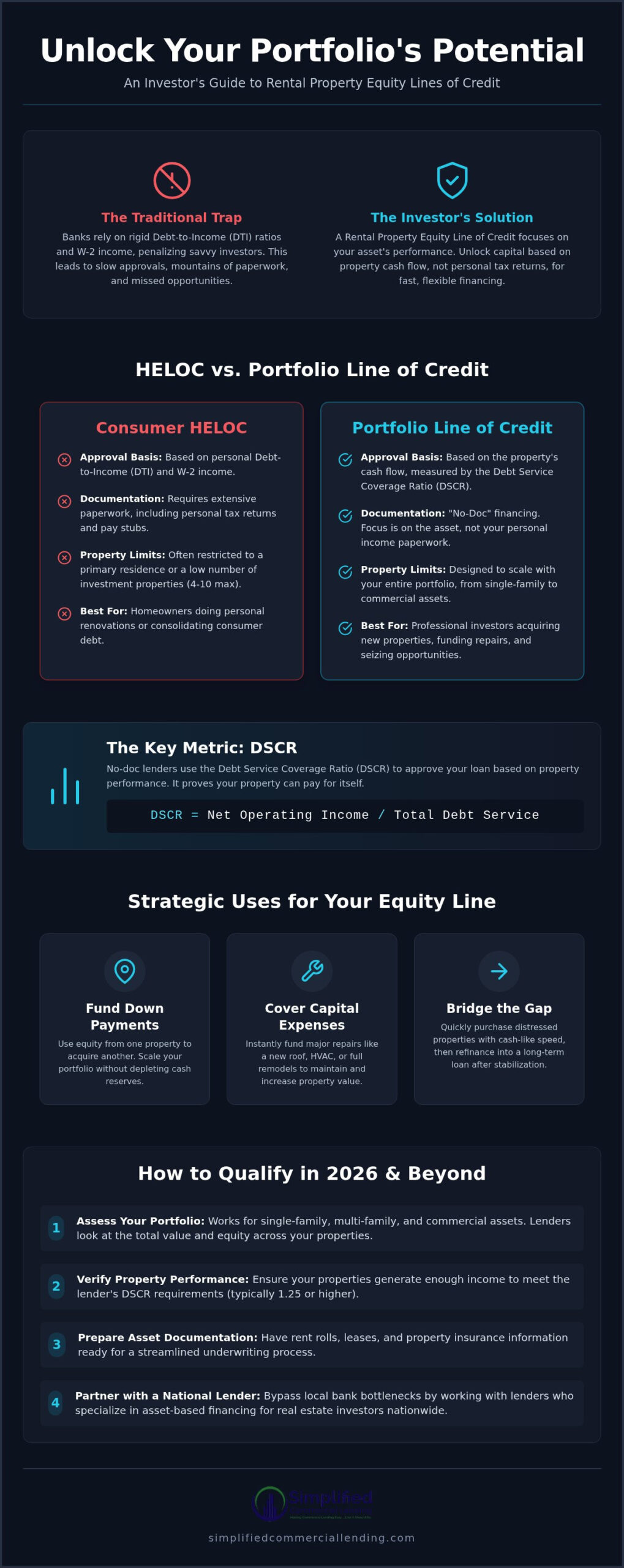
- Funding Down Payments: Use the equity from a stabilized property to cover the 20% or 25% down payment on your next acquisition. It allows you to scale without depleting your personal savings.
- Capital Expenditures (CapEx): Large-scale repairs like a new roof, HVAC system, or a full kitchen remodel can be paid for instantly. You don’t have to wait for months of rental income to pile up.
- Bridging the Gap: Use the line to buy a distressed property quickly, then refinance into a permanent loan once the asset is stabilized and renovated.
It’s a proactive way to manage your portfolio. You aren’t just reacting to the market; you’re prepared for it. Whether it’s an emergency repair or a surprise deal, you have the capital ready to move.
HELOC vs. Portfolio Line of Credit: Which is Better?
Most investors start their search at a local credit union. They assume a standard bank HELOC is the only way to tap into their gains. This is a mistake. Traditional banks design their products for homeowners, not entrepreneurs. While a consumer HELOC might offer a lower introductory rate, the strings attached can strangle your growth. If you want a rental property equity line of credit that scales with your ambition, you need to understand the difference between consumer-grade products and professional portfolio lines.
Choosing between these options isn’t just about the interest rate. It’s about control. A traditional bank HELOC is a consumer product. It’s designed for someone fixing a kitchen in their primary residence. A professional rental property equity line of credit is a business tool. It’s designed for the investor who needs to close a deal in two weeks without begging a loan officer for permission.
Consumer HELOC Limitations
Banks love W-2 income. They struggle with the reality of real estate investing. If you’ve been aggressive with depreciation to lower your tax bill, a traditional lender sees “paper losses.” To them, you look like a risk on paper. They also enforce strict Debt-to-Income (DTI) limits. Even if your rentals are cash-flowing, your personal debt load can block your approval. Most big banks also hit a wall once you own more than four to ten properties. They simply aren’t built for volume.
The Portfolio Advantage
A Portfolio Line of Credit changes the game. Instead of looking at your personal paystubs, the lender looks at the assets. These facilities allow you to cross-collateralize multiple single-family or multi-family properties under one limit. This consolidation creates a massive pool of liquidity. Because the underwriting focuses on the Debt Service Coverage Ratio (DSCR), your properties’ performance is the primary factor. As your portfolio grows, your line of credit can grow with it. This is how you move from owning three houses to thirty.
You’ll face a choice between variable rates and fixed-draw terms. Consumer HELOCs are almost always variable, leaving you exposed to market shifts. Portfolio lines often offer more structure. While rates for portfolio products as of August 2026 generally range from 0.5 to 2 percentage points higher than conventional mortgages, the flexibility is worth the cost. You aren’t just paying for money; you’re paying for the ability to move fast. If you’re ready to stop jumping through bank hoops, check out how we structure Portfolio Lines of Credit for active investors.
DSCR-Based Equity Access: Tapping Equity Without Tax Returns
Traditional banks want to know your entire life story. They demand every personal tax return from the last three years, every W2, and a detailed list of your personal expenses. This is the old way of doing things. A rental property equity line of credit should be based on the property’s ability to pay for itself, not your personal salary. This is where the Debt Service Coverage Ratio (DSCR) comes in. It shifts the underwriting focus from your personal bank account to your property’s performance. It’s a game-changer for investors who are tired of being penalized for their tax deductions.
Your property’s performance is the most reliable indicator of loan safety. If a rental asset generates consistent cash flow that covers its own debt, it’s a sound investment. We prioritize this reality over your personal debt-to-income (DTI) ratio. This approach allows you to scale your portfolio indefinitely. You aren’t limited by how much you earn at a day job; you’re only limited by how well your properties perform. It is the ultimate path to financial freedom for the independent entrepreneur.
Understanding the DSCR Calculation
DSCR is gross rental income divided by PITI (Principal, Interest, Taxes, and Insurance). Lenders typically look for a ratio of 1.20 or higher as the “gold standard.” This ratio proves the property generates 20% more income than its monthly obligations. It provides a safety cushion for both the lender and the investor. For those in the short-term rental market, the underwriting is even more specialized. We analyze actual Airbnb or VRBO income history rather than just conservative long-term averages. This ensures your high-yield vacation rentals are valued for their true earning potential. Investors expanding into hospitality assets can apply the same DSCR principles when exploring hotel financing for investors to fund acquisitions based on RevPAR and operational cash flow rather than personal income.
The “No-Doc” Advantage for Entrepreneurs
The term “No-Doc” is often misunderstood. It doesn’t mean there is no underwriting; it means we don’t need your 1040s, W2s, or complex personal financial statements. As a savvy investor, you likely use legal depreciation and business expenses to lower your taxable income. While this is smart for your bottom line, it makes you look “unqualified” to a traditional bank. Asset-based lending ignores those paper losses. Because we don’t have to wade through hundreds of pages of personal tax data, the speed of execution is significantly faster. You can Scale your rental portfolio without tax returns and close deals while your competitors are still waiting for a bank’s “underwriting committee” to meet. This efficiency allows you to act on opportunistic buys the moment they hit the market.
How to Qualify for a Rental Equity Line of Credit in 2026
Qualification for a rental property equity line of credit shouldn’t feel like a deposition. While traditional banks treat you like a liability, asset-based lenders treat you like a business partner. We don’t care about your W2. We care about your properties. If your portfolio is healthy and your credit is solid, you’re already halfway there. This process is designed for speed, focusing on the actual value of your assets rather than your personal history.
You can leverage single-family homes, multi-family units, and even commercial properties. The key is to demonstrate that these assets are productive. Lenders in 2026 look for a clear track record of cash flow and a manageable debt load. Stop worrying about your tax returns; start focusing on your rent roll. This approach allows you to secure a rental property equity line of credit without the friction of traditional underwriting.
Step 1: Property and Portfolio Assessment
Your first move is to verify your current Loan-to-Value (LTV) ratio. Most professional lenders look for an LTV of 75% or lower to unlock the best terms. This ensures there is enough skin in the game to protect the investment. Your properties must be “rent-ready.” This means they are either currently leased or actively listed for rent. A vacant property that needs a total gut-job won’t qualify for a revolving line. You need to Tap equity from your rental portfolio by showing that your assets are stabilized and generating income today.
Step 2: Financial and Credit Readiness
Your personal debt-to-income (DTI) ratio is irrelevant here. However, your credit score still plays a role. A healthy mid-FICO score, typically 680 or higher, proves you manage your financial obligations responsibly. You’ll also need to organize your documentation. Forget the tax returns. Instead, prepare a clean rent roll and copies of your current lease agreements. Lenders will also verify your liquidity. You should have enough cash on hand to cover closing costs and maintain initial reserves, usually equal to three to six months of mortgage payments. This liquidity proves you can handle a temporary vacancy without breaking a sweat. If you’re expanding into commercial assets and want to understand how property-level cash flow drives approval decisions, our guide to commercial real estate cash flow loans walks through the full qualification framework for 2026.
If you’re ready to bypass the bank and use your assets to fund your next move, apply for a portfolio line of credit today. Our team focuses on your growth, not your paperwork.
Scale Your Portfolio with Simplified Commercial Lending
Local banks are fine for car loans or primary mortgages. They rarely understand the needs of a scaling real estate entrepreneur. Simplified Commercial Lending is different. We act as your savvy expert guide, navigating the bottlenecks of traditional finance to get you the capital you need. Our rental property equity line of credit options are built on a foundation of pragmatism. We care about the cash flow of your assets, not the size of your W-2. We’re here to alleviate the anxiety of rigid banking norms and replace them with a disruptive, solution-oriented approach.
Whether you’re managing a handful of single-family rentals, a multi-family complex, or even a large commercial warehouse, our approach remains the same. We prioritize speed and flexibility. We offer asset-based lending that recognizes your properties as the primary source of security. This removes the frustration of personal income verification and allows you to move at the speed of the market. Our process is designed to be direct and results-oriented, cutting out the fluff that usually bogs down commercial deals. By focusing on your growth rather than your paperwork, we provide a rental property equity line of credit that functions as a true business tool. Investors who want to diversify beyond residential assets can also explore our approach to hotel financing for investors, where the same asset-based principles apply to high-performing hospitality properties.
National Reach for National Portfolios
Many investors hit a wall when their portfolio crosses state lines. Local credit unions often can’t lend outside their immediate region. We solve this problem. We serve investors across the entire United States. It doesn’t matter if your properties are in one state or ten. You get one point of contact for your entire multi-state portfolio. This streamlined communication is essential for maintaining momentum. If you’re looking to expand into new asset classes, check out our Guide to commercial property loans to see how we handle everything from residential to commercial assets across the country.
Get Started Today
Momentum is the most valuable asset an investor has. Don’t let a slow bank approval kill your next deal. It’s time to leverage a line of credit that truly understands the value of your cash-flowing assets. We’ve removed the traditional hurdles to make scaling your business as fast as possible. This isn’t just about getting a loan; it’s about finding a partner who values your results over rigid protocols. Stop waiting for bank committees and start executing your strategy. Take the first step toward a more flexible financial future today. You can Unlock Your Equity with Simplified Commercial Lending and get the liquidity you need to dominate the 2026 market.
Take Control of Your Portfolio’s Growth
Traditional bank hurdles shouldn’t stop your momentum. By choosing a portfolio-based rental property equity line of credit, you bypass the debt-to-income traps and tax return scrutiny that plague consumer loans. Asset-based lending allows your properties to prove their own value, creating a flexible capital engine for your business. You’ve built the equity; now it’s time to put it to work.
We’ve streamlined the process with no tax returns required and national US coverage. Our DSCR-based underwriting ensures that if your properties cash flow, you qualify. You can manage a multi-state portfolio from a single point of contact without the headache of local bank committees. Don’t let rigid institutional norms hold your ambition hostage.
Ready to pull the trigger on your next acquisition? Access Your Rental Equity Today and stop letting paperwork dictate your potential. Your vision for a massive portfolio is within reach, and we’re here to provide the tools to build it.
Frequently Asked Questions
Can I get a HELOC on a rental property without tax returns?
Yes, but not from a traditional bank. You need a rental property equity line of credit from an asset-based lender. These lenders use Debt Service Coverage Ratio (DSCR) instead of tax returns. This means your property’s monthly income must cover the mortgage, taxes, and insurance. It’s a faster way to unlock equity because it ignores your personal 1040s and W2s. This approach is ideal for entrepreneurs who use legal deductions to lower their taxable income.
What is the maximum LTV for a rental property equity line of credit?
Most commercial lenders cap the Loan-to-Value (LTV) at 75% for investment properties. This threshold ensures the property maintains enough equity to protect the lender and the investor. While some consumer HELOCs on primary residences might go higher, professional portfolio lines prioritize safety and cash flow. Keeping your LTV around 75% or lower often qualifies you for the most competitive terms and larger credit limits across your entire real estate portfolio.
How does a portfolio line of credit differ from a standard home equity loan?
A portfolio line is a revolving credit facility, while a home equity loan is a one-time lump sum. With a portfolio line, you only pay interest on what you draw. It also allows you to cross-collateralize multiple rentals under a single credit limit. Standard home equity loans are typically consumer products for primary residences. A portfolio line is a specialized business tool designed specifically for scaling real estate investors who need liquidity.
Can I use equity from an Airbnb or short-term rental?
Yes, short-term rentals are eligible for equity lines of credit. Underwriting for these assets involves analyzing the actual rental history from platforms like Airbnb or VRBO. Lenders look for a consistent track record of income that satisfies the required DSCR. This allows you to tap into the high-yield value of vacation rentals to fund new acquisitions or cover large maintenance costs without the friction of providing personal income documentation or traditional tax returns.
Is a rental property line of credit available for multi-family buildings?
Yes, multi-family residential investment loans can be structured as lines of credit. This includes duplexes, triplexes, and larger apartment complexes. These properties often have strong DSCR profiles, making them excellent candidates for asset-based financing. By leveraging the equity in a multi-family building, you can secure a larger credit limit than you would with a single-family home. This provides more liquidity for your next major project or opportunistic buy in the commercial market.
How long does it take to close on an investment property equity line?
Closing times typically range from 30 to 45 days. Because asset-based lenders don’t require personal tax returns or complex debt-to-income verification, the process is much faster than a traditional bank loan. The timeline mostly depends on the speed of the property appraisal and the title search. Having your rent roll and lease agreements ready from the start can help accelerate the underwriting and get you funded much sooner than a local credit union.
Are interest rates higher for rental property lines of credit?
Rates for investment properties are generally 0.5% to 2% higher than those for primary residences. This reflects the increased risk lenders associate with non-owner-occupied assets. However, the trade-off is the flexibility and ease of qualification. You aren’t being judged on your personal income or DTI. For many investors, the ability to close quickly and scale a rental property equity line of credit without tax returns outweighs the slightly higher interest cost.
What is the minimum credit score for a commercial portfolio line?
Most lenders look for a mid-FICO score of 680 or higher. While your personal income doesn’t determine eligibility, your credit score serves as a measure of your financial responsibility. A higher score often unlocks better terms and higher LTV limits for your portfolio. If your score is slightly lower, some programs may still be available if the property’s cash flow is exceptionally strong, but 680 remains the standard benchmark for most commercial portfolio lines.