Your personal tax returns shouldn’t be the gatekeeper to your next commercial acquisition. For too long, traditional banks have prioritized piles of paperwork over actual property performance. If you’re tired of onerous documentation and slow approval times, you’re not alone. Most independent investors find the traditional process for securing retail center financing to be a confusing, bureaucratic maze that ignores the real value of multi-tenant income.
It’s time to stop jumping through hoops and start focusing on property cash flow. We believe that securing a loan should be empowering, not exhausting. This article provides a comprehensive checklist designed to help you master the complexities of retail property loans without the typical institutional headaches. You’ll learn how to position your asset for success and access capital based on what your property actually earns rather than your personal debt-to-income ratio.
We’ve mapped out a clear path to funding that prioritizes speed and flexibility. This preview of the 2026 lending landscape covers everything from property-level requirements to the advantages of asset-based underwriting. You’ll walk away with a practical roadmap to navigate the financing process and secure the terms your investment deserves.
Key Takeaways
- Learn why modern retail center financing focuses on property cash flow instead of your personal tax history.
- Discover how a 680+ credit score and clear liquidity proof unlock the most aggressive loan terms available.
- Master the art of auditing rent rolls to eliminate “dark center” risks and impress asset-based underwriters.
- Prepare a bulletproof documentation package with certified rent rolls and multi-year P&L statements to accelerate your funding.
- Navigate the closing process with confidence by knowing exactly what to look for in your term sheet beyond the interest rate.
Understanding Retail Center Financing Options in 2026
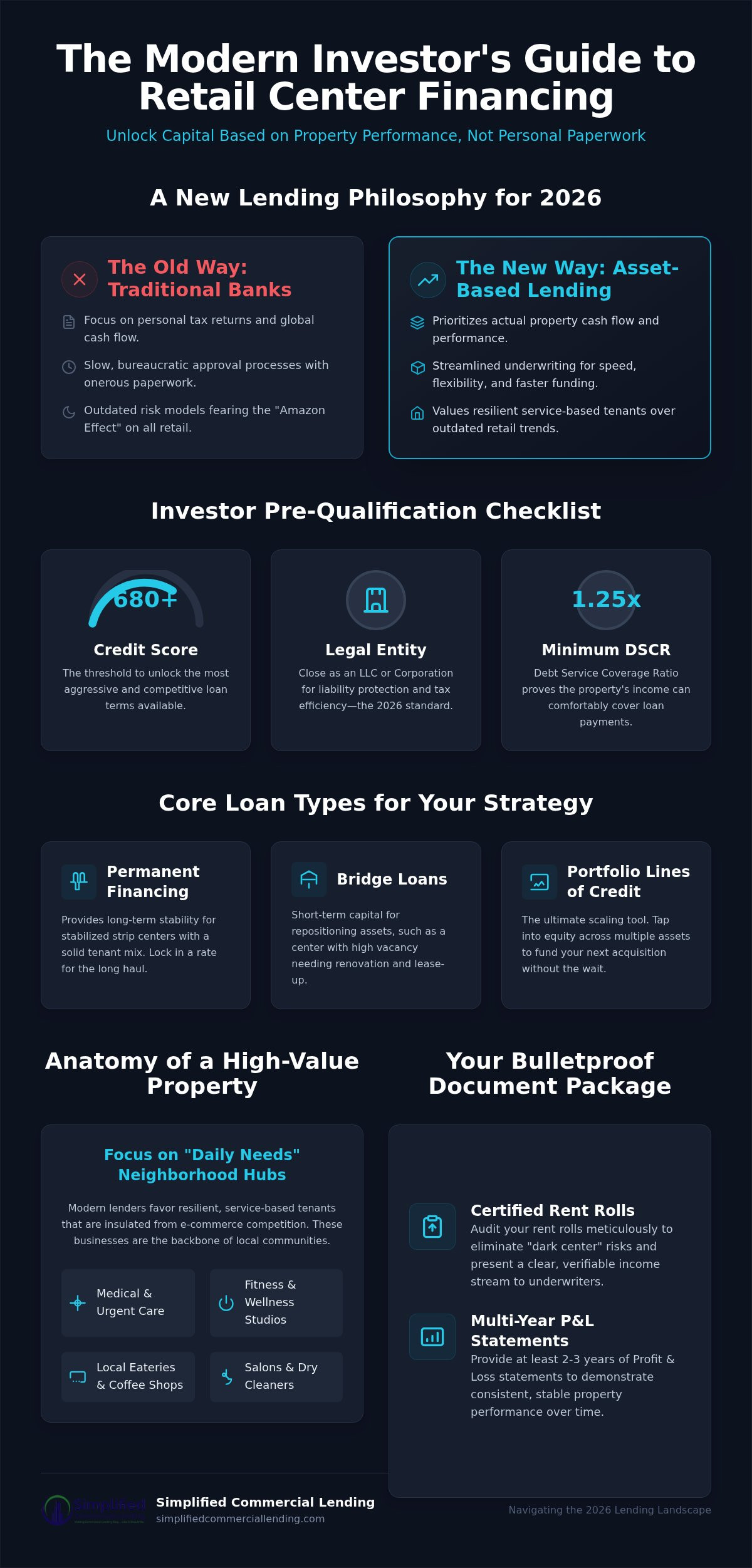
Retail center financing is a specialized commercial mortgage designed for multi-tenant or single-tenant properties. It isn’t just about getting a loan; it’s about matching capital to the specific rhythm of retail income. In 2026, we’re seeing a massive shift toward neighborhood “daily needs” centers. These properties house the services people can’t get from an app: medical clinics, fitness studios, and local eateries. This resilience makes them prime candidates for competitive retail center financing.
Traditional banks still treat these assets with suspicion. They use outdated models that prioritize your personal tax returns over the property’s actual performance. Modern non-bank lending takes a different approach. It focuses on asset-based underwriting. This is the ultimate shortcut for investors. If the property’s cash flow is strong, the deal gets done. It’s a pragmatic shift that values the actual revenue generated by your tenants over your personal debt-to-income ratio.
In 2026, the most successful investors are targeting neighborhood hubs. These centers are the backbone of local communities. They aren’t competing with online giants. Instead, they provide essential services like urgent care, dry cleaning, and boutique fitness. When you focus on these high-traffic assets, you’re betting on human habit rather than retail trends. Asset-based lenders recognize this stability and move much faster than traditional institutions.
The Core Loan Types: Which Fits Your Strategy?
You need the right tool for the job. Depending on your investment goals, you’ll likely choose one of these three paths to secure your funding:
- Permanent Financing: This provides long term stability for stabilized strip centers. Use this when your tenant mix is solid and you want to lock in a rate for the long haul.
- Bridge Loans: These offer short term capital for repositioning assets. If you’re buying a center with 40% vacancy, a bridge loan gives you the funds to renovate and find new tenants before refinancing.
- Portfolio Lines of Credit: This is the ultimate scaling tool. It allows you to tap into the equity across multiple retail assets to fund your next acquisition without the wait.
Why Traditional Banks Struggle with Retail in 2026
The traditional banking system is often stuck in the past. Many lenders still buy into the “Amazon Effect” myth, fearing that all physical retail is doomed. They fail to see the massive growth in service-based businesses that require a physical presence. Salons, dental offices, and coffee shops can’t be replaced by a delivery drone. These businesses are exactly what make modern retail centers so attractive to savvy lenders.
Beyond that, rigid personal requirements are a major hurdle. Big banks want to see your personal tax returns, your global cash flow, and every detail of your financial history. Working with a no doc commercial loan broker changes the equation. These experts specialize in non-bank financing that looks at the property’s performance. It’s about how much money the center makes, not how much you personally earned last year. This approach provides the speed and flexibility you need to close deals in a competitive market.
Pre-Qualification Checklist: Assessing Your Investment Readiness
Before you dive into the search for the perfect property, you must ensure your own financial house is in order. Success in retail center financing starts with a clear-eyed assessment of your personal and entity-level readiness. Even in an asset-based lending environment, lenders use your profile to determine the level of risk they’re assuming. You don’t need to be a billionaire, but you do need to prove you’re a capable steward of the capital you’re requesting.
Your credit score remains a vital tool for pricing. While we prioritize the property’s income, a credit score of 680 or higher is usually the threshold that unlocks the most competitive interest rates. If your score is lower, you can still secure funding, but you’ll likely face higher costs. Additionally, you should plan to close the deal under a legal entity. Financing retail centers through an LLC or Corporation is the 2026 standard for both liability protection and tax efficiency. It signals to the lender that you’re operating a professional investment business rather than a hobby.
Finally, know your baseline Debt Service Coverage Ratio (DSCR). Most lenders look for a 1.25x ratio. This means the property’s net operating income should be 25% higher than the annual debt obligations. If you’re unsure where you stand, you can explore your options with a specialist to get a realistic view of your borrowing power.
The Liquidity and Net Worth Test
Lenders still want to see “skin in the game.” Even with no-doc options, you must demonstrate you have the staying power to handle unexpected vacancies or roof repairs. Most non-bank lenders require 6 to 12 months of mortgage reserves to be held in liquid accounts. If you’re short on cash, don’t panic. You can often use existing equity from other properties in your portfolio to meet down payment requirements rather than depleting your cash reserves. For 2026 retail acquisitions, lenders typically require liquid assets equal to at least 10% of the total loan amount to ensure long-term property stability.
Experience Matters: Your Investor Resume
Lenders prefer borrowers who have “been there and done that.” If you have a track record of managing multi-tenant commercial assets, you’ll find the approval process much smoother. For first-time retail buyers, the path to funding involves mitigating the lender’s fear of the unknown. The best strategy is to hire a professional third-party property management firm with a proven retail track record. This move instantly adds institutional-grade expertise to your application. Building a solid resume is part of a broader commercial property loan strategy that prioritizes long-term growth and portfolio scalability.
Property Performance Checklist: What Lenders Look for in Retail Assets
Lenders don’t just lend to you; they lend to the building. When you’re securing retail center financing, the property’s performance is the star of the show. You need to prove the asset can sustain itself and thrive even if the economy stutters. This starts with a deep dive into your rent roll. Look for staggered lease expirations. If all your tenants’ leases end in the same 12 month period, you’re facing a “dark center” risk that will terrify most underwriters. A well-laddered expiration schedule proves you’ve managed the asset with foresight.
Don’t forget the paperwork that binds these relationships. Estoppel certificates are essential for any serious commercial acquisition. These documents ensure that tenants and owners agree on the lease terms, security deposits, and any outstanding landlord obligations. Without them, a lender is flying blind. You also need a clean Phase I Environmental report. In 2026, environmental liability is a deal killer. Lenders won’t touch a property with potential soil or groundwater contamination, so get this audit done early to avoid a last-minute collapse of your deal.
Analyzing the Tenant Mix
Your tenant mix is your property’s heartbeat. “Un-Amazonable” tenants are the gold standard for 2026 lenders. Think salons, medical offices, and high-intensity gyms. These businesses require physical presence and drive consistent foot traffic that digital retailers can’t touch. Be wary of tenant concentration. If one tenant occupies more than 50% of your square footage, your risk profile spikes. Lenders also prefer NNN (Triple Net) leases over gross leases. These agreements shift the burden of taxes, insurance, and maintenance to the tenant, creating a much more predictable and stable cash flow for the property.
Location and Market Dynamics
Physical access is just as important as the tenants inside. High traffic counts mean nothing if your customers can’t figure out the ingress and egress. Lenders want to see easy turns and clear visibility from the main road to ensure the center remains a convenient destination. Proximity to major players matters too. Shadow-anchored centers, which sit adjacent to a major grocery store or national “big box” retailer without owning it, are highly prized. Proximity to a high-traffic grocery anchor often allows lenders to offer higher LTV ratios because the constant flow of “daily needs” shoppers significantly lowers the risk of vacancy.
The Documentation Checklist: Streamlining the Application Process
Documentation is the bridge between your vision and the closing table. Many investors dread this phase because big banks treat it like a root canal. If you’re pursuing retail center financing, you can bypass the institutional sludge by focusing on what actually matters: the asset. Modern lending is about efficiency. You don’t need a mountain of paperwork; you need the right paperwork. Having these files ready at the start can shave weeks off your approval timeline.
Start with your property financials. You’ll need the last 2 years of Profit and Loss (P&L) statements along with a current year-to-date (YTD) report. This shows the trajectory of the center’s income and expense management. Next, provide a certified rent roll. It must detail lease start and end dates, square footage for each unit, and security deposits held. Finally, keep full copies of all active tenant contracts and a Personal Financial Statement (PFS) ready. The PFS is just a snapshot of your assets and liabilities, not an invitation for a deep-dive into your personal life.
The “No Tax Return” Advantage
Stop digging through old tax folders. Traditional banks put you through a “Full Doc” nightmare that can take months to process. Asset-based lending flips the script. Your property’s cash flow is your most powerful document. Instead of personal tax returns, lenders rely on verified bank statements showing rent deposits and a professional property appraisal. This approach prioritizes the property’s ability to pay the mortgage. Ready to skip the tax return hassle? Apply for a no-doc commercial loan today and get a decision based on your property’s actual potential.
Environmental and Appraisal Reports
These third-party reports are the final hurdles in the documentation phase. A Phase I Environmental Site Assessment (ESA) checks for historical contamination or nearby risks. It’s a standard safety net for lenders in 2026 to ensure the land is clean. Simultaneously, a commercial appraisal will determine the “As-Is” value versus the “Stabilized” value. The “As-Is” value reflects the property today, while “Stabilized” value considers what it’s worth once vacant units are filled. To prepare for the appraiser, ensure all common areas are clean and all vacant units are accessible. A well-maintained property helps the appraiser see the stabilized potential rather than just the current state.
Closing the Deal: Moving from Application to Funding
You’ve navigated the checklists and gathered the documents. Now comes the most critical phase: crossing the finish line. The transition from applicant to owner happens in the final weeks of the closing process. This is where your attention to detail pays off. The term sheet is your first real look at the deal’s structure. Don’t let a low interest rate blind you to other vital factors. You must scrutinize prepayment penalties that could trap you in a loan when you’re ready to sell. Also, check for recourse requirements. Many modern lenders now offer options that protect your personal wealth from property-level risks.
Underwriting is where the deal is solidified. During this stage, the lender’s team verifies every detail of your retail center financing package. They will inevitably issue “conditions,” which are simply requests for additional clarity or minor documents. Speed is your best friend here. Respond to every condition within 24 hours. This proactive approach keeps the momentum high and prevents the deal from cooling off. Delays in underwriting are often the primary reason closings get pushed back, which can strain your relationship with the seller.
Finally, prepare for the financial reality of the closing table. You need to budget for closing costs and escrow requirements. This includes title insurance, legal fees, and loan origination points. Ensure your liquidity is ready to move when the call comes. Once the escrow company receives the funds and the deed is recorded, the process is complete. You are no longer just a borrower; you are the owner of a cash-flowing retail asset.
Negotiating Your Loan Terms
Should you choose a fixed-rate or a floating-rate loan? In the 2026 economy, fixed rates provide the long-term peace of mind needed for stabilized assets. Floating rates might offer lower initial costs if you plan to reposition and exit the property quickly. Protecting your personal assets is equally important. Non-recourse loans ensure that the lender’s only collateral is the property itself. While a warehouse purchase loan might involve similar environmental audits, retail deals require more focus on tenant lease expirations and staggered income streams.
Next Steps: Get Your Custom Quote
Speed is your greatest leverage in a competitive market. The investor who can move from a handshake to a funded loan the fastest usually wins the best properties. We specialize in cutting through the institutional red tape that slows down big banks. By focusing on your property’s cash flow rather than your personal tax history, we provide a streamlined path to capital. It’s time to stop waiting on bureaucratic approvals and start growing your portfolio. Ready to scale? Get a customized retail center loan quote today.
Secure Your Next Retail Acquisition Today
Success in 2026 belongs to investors who prioritize property performance over personal paperwork. You’ve learned that a strong tenant mix and a clear understanding of cash flow are the real keys to unlocking capital. By focusing on your asset’s daily needs resilience rather than outdated banking requirements, you position yourself to move faster than the competition. The path to securing retail center financing doesn’t have to be a bureaucratic nightmare.
We’re here to help you bypass the traditional hurdles. As an expert brokerage for complex multi-tenant assets, we provide a streamlined alternative to institutional norms. We offer no tax returns required options and provide national reach across the USA for investors who value efficiency. It’s time to stop letting big banks dictate your growth and start using a partner that understands the independent entrepreneur’s ambition.
Your next deal is waiting. Apply for Retail Center Financing Without Tax Returns and experience a faster, more flexible way to fund your commercial goals. You’ve got the roadmap; now it’s time to take the lead and scale your portfolio with confidence.
Frequently Asked Questions
What is the typical down payment for a retail center loan in 2026?
Expect to provide a down payment of 20% to 30% for most retail centers. Lenders typically look for a Loan-to-Value (LTV) ratio between 70% and 80% for stabilized assets. If you have significant equity in other properties, you might be able to use that to cover your “skin in the game” requirements. This flexibility is a hallmark of modern asset-based lending.
Can I get retail center financing without showing my personal tax returns?
You can definitely secure retail center financing without showing personal tax returns. Many non-bank programs focus exclusively on the property’s cash flow and your credit score. This “no-doc” approach is perfect for independent investors who have complex tax situations but own high-performing properties. It’s a pragmatic way to fund your next deal based on the asset’s actual success.
What is a good DSCR for a shopping center?
A DSCR of 1.25x is the standard benchmark for most shopping centers. This ratio proves that the property earns 25% more than the cost of the mortgage. Lenders use this number to ensure there’s enough of a buffer to handle minor tenant turnover. If your property hits 1.35x or higher, you’ll likely see even more competitive offers from non-bank lenders.
How long does it take to close a commercial loan on a retail property?
Expect a closing timeline of 30 to 45 days for retail center financing when working with a non-bank lender. Traditional big banks often drag the process out for 60 to 90 days because of their bureaucratic layers. If you have your documentation checklist ready, you can accelerate the process. Speed is a massive advantage when you’re trying to win a deal in a hot market.
What is the difference between an anchored and unanchored retail center?
Anchored centers feature a major national tenant, like a grocery store or pharmacy, that drives consistent traffic. Unanchored centers consist of smaller shops without a single dominant “draw.” Anchored properties are often seen as lower risk by underwriters. However, unanchored centers can offer higher yields if the tenant mix is resilient and provides essential services that can’t be replaced by online shopping.
Do lenders require a Phase I Environmental report for all retail centers?
Lenders almost always require a Phase I Environmental report for retail properties to protect against historical liability. This audit looks for contamination from previous tenants like dry cleaners or gas stations. It protects you from buying a liability that could cost millions to remediate. Getting this report early prevents your funding from hitting a wall right before your scheduled closing date.
Can I use a portfolio line of credit to purchase a new retail property?
A portfolio line of credit is an excellent tool for purchasing a new retail property. It allows you to borrow against the collective equity of your existing investment holdings. This provides a ready source of cash for down payments or full acquisitions. It’s a strategic way to scale your footprint quickly without the friction of multiple individual loan applications for every new deal.
What happens if my retail center has high vacancy?
If vacancy is high, you’ll likely need a bridge loan to reposition the asset. Permanent financing usually requires at least 85% occupancy to prove the center is stabilized. A bridge loan gives you the capital to renovate and attract new tenants. Once you’ve filled the space and increased the income, you can transition into a long-term commercial property loan with better rates.