Your personal debt-to-income ratio is a poor measure of your success as a real estate investor, yet traditional banks continue to treat it like the ultimate gatekeeper. It’s frustrating to watch a prime deal slip away because a loan officer is obsessed with your tax returns instead of the property’s potential. You want to scale, but rigid institutional norms keep you stuck in a cycle of slow approvals and arbitrary lending caps. Securing single family residential investment loans should be about the strength of the deal, not the length of your personal financial history.
In this guide, you’ll learn how to secure financing by focusing on property cash flow instead of personal income. We’ll show you how to navigate the 2026 landscape, including the impacts of the 21st Century ROAD to Housing Act and the latest DSCR trends. You’ll discover how to pull equity from your current rentals to fund new acquisitions and close deals in weeks, not months. It’s time to stop asking for permission from banks and start building your wealth on your own terms.
Key Takeaways
- Discover why single family residential investment loans prioritize property cash flow over your personal debt-to-income ratio.
- Learn how to use the Debt Service Coverage Ratio (DSCR) to secure funding without providing personal tax returns.
- Identify the credit score and LTV benchmarks required to access the most competitive asset-based rates in today’s market.
- Master the strategy of leveraging equity from your current rentals to scale your portfolio through specialized lines of credit.
- Find out how to bypass traditional banking red tape with streamlined, no-doc underwriting designed for fast closings.
What Are Single Family Residential Investment Loans?
Single family residential investment loans are specialized credit products built for one purpose: acquiring or refinancing income-producing 1-4 unit properties. They aren’t your typical neighborhood mortgage. While a standard bank loan focuses on your personal ability to pay, an investment loan focuses on the property’s ability to pay. Traditional banks treat you like a consumer; asset-based lenders treat you like a business owner. This distinction is the secret to scaling a portfolio without getting bogged down in personal financial scrutiny.
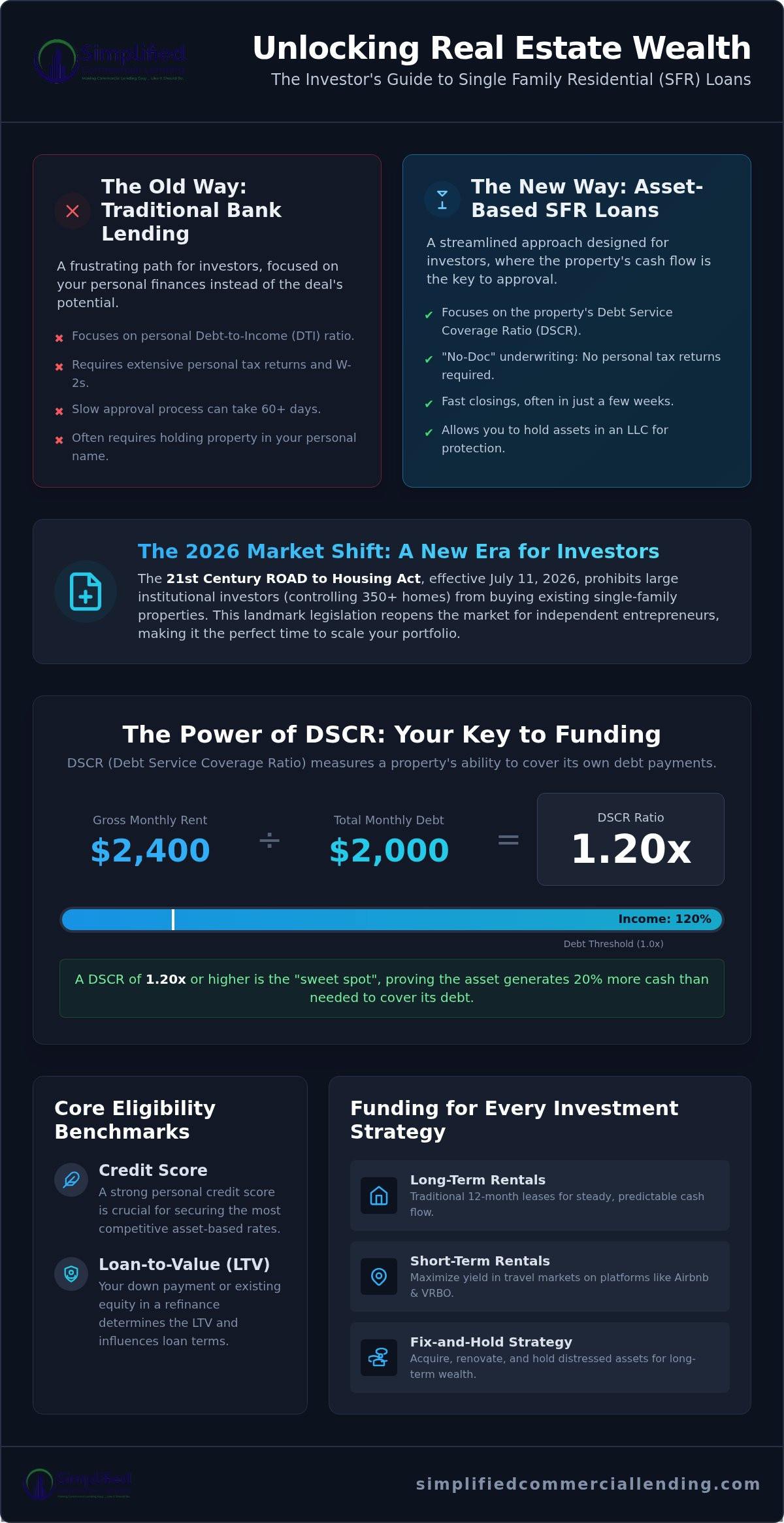
The landscape changed fundamentally on July 11, 2026, with the enactment of the 21st Century ROAD to Housing Act. This landmark legislation prohibits large institutional investors, those controlling 350 or more homes, from purchasing existing single-family properties. This regulatory shift has sidelined the giants and reopened the market for independent entrepreneurs. 2026 is the year for smaller investors to reclaim the single-family rental (SFR) market. To capitalize on this opening, you need financing that moves as fast as the market does.
Commercial-style investment loans bypass the rigid institutional norms that stall growth. Instead of checking if your salary can cover another mortgage, these loans analyze the Debt Service Coverage Ratio (DSCR). If the property makes money, the deal makes sense. This approach allows you to treat each property as a standalone business entity. It’s a proactive way to build wealth that prioritizes pragmatism over protocol.
The Shift from Personal Income to Property Income
Your debt-to-income (DTI) ratio is often the biggest hurdle in traditional lending. Banks look at your personal monthly obligations and compare them to your W-2 income. This model is broken for investors. Single family residential investment loans solve this by using the property as the primary collateral and income source. Modern “no-doc” lending has evolved from the risky practices of the past into a sophisticated tool for the savvy entrepreneur. We don’t need your tax returns to see that a property is a winner. We look at the lease, the market rent, and the cash flow. If the asset performs, you get funded.
Types of SFR Investment Properties We Finance
Success in 2026 requires flexibility across different rental models. We provide the capital for various strategies, including:
- Long-term rentals: Traditional 12-month leases that provide steady, predictable monthly cash flow.
- Short-term rentals: Properties listed on platforms like Airbnb or VRBO that maximize yield in high-demand travel markets.
- Fix-and-hold strategies: Acquiring distressed assets, renovating them, and keeping them as long-term wealth generators.
Each of these models requires a navigator who understands the nuances of asset-based lending. Whether you are buying your second rental or your fiftieth, the goal is the same: streamlined procedures and practical outcomes.
DSCR vs. Traditional Financing: Why Cash Flow Wins
Why do traditional banks make it so hard for investors? They’re looking at you, not the deal. If you’ve ever been denied because your tax write-offs made your personal income look “too low” for a standard mortgage, you know the frustration. Conventional lenders want predictable W-2s. They don’t understand the life of a real estate entrepreneur. Traditional bank rejection is a common hurdle when applying for single family residential investment loans, but asset-based lending offers a faster path forward.
This is where DSCR (Debt Service Coverage Ratio) financing changes the game. It’s built on logic. Instead of months of back-and-forth regarding your personal history, you get an answer based on the property’s performance. Speed is your greatest competitive advantage in 2026. While a competitor waits 60 days for a bank to review their 1040s, you’ve already closed and moved on to the next acquisition. Most conventional loans also force you to hold properties in your personal name. Asset-based lenders allow you to use an LLC, which protects your personal assets and simplifies portfolio management as you grow.
How to Calculate Your DSCR
The math is straightforward. Take your Net Operating Income (NOI) and divide it by your Total Debt Service (your annual mortgage payments). DSCR is the ratio of rental income to mortgage payment. If a property brings in $2,400 monthly and the mortgage is $2,000, your ratio is 1.2x. A 1.2x ratio is often the “sweet spot” for lenders. It proves the asset generates 20% more cash than the debt requires, providing a healthy safety net for maintenance and vacancies.
The “No-Doc” Advantage for Scaling
Stop digging through filing cabinets for old tax returns. Professional investors prefer asset-based underwriting because it’s efficient. We qualify the loan based on the property’s 1007 Rent Schedule, an appraiser’s professional estimate of what the home will earn on the open market. If the market rent covers the debt, you’re in. This streamlined approach is why savvy investors choose modern cash-flow lending over traditional bank hurdles. It allows you to focus on finding deals instead of managing paperwork. Using single family residential investment loans backed by property performance lets you scale without the ceiling of personal debt-to-income limits. Investors who want to go deeper on this strategy should explore no doc rental property loans and how they unlock capital that traditional lenders keep out of reach.
Eligibility Requirements for SFR Investment Loans
While we bypass the tax return scavenger hunt, we don’t ignore your financial health entirely. Securing single family residential investment loans requires a blend of personal credit strength and property potential. You don’t need a perfect history, but you do need a solid foundation. Lenders use these requirements to manage risk while still moving faster than any traditional bank ever could. The process is designed to be transparent and results-driven, focusing on your ability to manage the asset effectively.
Credit and Capital Requirements
Your FICO score serves as a proxy for your management style. A score of 680 is the standard entry point for most asset-based products. To unlock the most aggressive rates, which currently range from 6.12% to 7.25% for strong borrowers, aim for a score above 720. Capital is the second pillar of eligibility. Down payments in 2026 have stabilized at 20% for most single-family assets. This loan-to-value (LTV) ratio provides enough equity to weather the 1.6% national rent decline seen in the first half of the year. It protects your investment and our capital simultaneously. We are flexible on the source of these funds. You can use business capital, liquidated assets, or even gift equity. The goal is to show you have skin in the game without the bureaucracy of traditional bank sourcing rules.
Property Standards and Appraisals
The property is the star of the show in asset-based underwriting. The appraisal process is where the deal lives or dies. We focus heavily on the Form 1007 rent schedule. This document analyzes local market data to determine a property’s realistic income. In a cooling market, this analysis is vital. It prevents you from over-leveraging based on outdated rental peaks. We also distinguish between property types. Traditional single-family homes are the gold standard for single family residential investment loans. If you are looking at condos or townhomes, we will check if they are “warrantable.” While conventional Fannie Mae guidelines are strict here, asset-based lending is generally more flexible, allowing for a wider variety of investment targets.
Don’t forget about liquidity. Most lenders require a “reserve” of six months of principal, interest, taxes, and insurance (PITI). This ensures that a single bad tenant or a 7.3% vacancy spike won’t sink your investment. It is a pragmatic requirement that builds a more resilient portfolio. Having these funds set aside proves your portfolio has staying power. It transforms you from a casual landlord into a professional investor with the resources to survive market fluctuations.
How to Scale Your Portfolio with Asset-Based Lending
Scaling isn’t just about buying more houses. It’s about how you use the capital you already have. Traditional banks often cut you off after your tenth property. They see risk where we see opportunity. Asset-based single family residential investment loans are the engine for this growth. By focusing on the asset, you can build a snowball effect that moves faster than any conventional mortgage allows. We prioritize pragmatism over protocol, ensuring your momentum doesn’t stall due to arbitrary lending limits.
Tapping Equity from Your Existing Rentals
Don’t let your equity sit idle. Many investors make the mistake of selling their best-performing assets to fund new ones. This triggers capital gains taxes and loses you a long-term winner. Instead, use a strategic cash-out refinance. Borrowing against your equity isn’t a taxable event. It gives you the “buy box” ready funds needed to pounce on new deals. A portfolio line of credit is even more powerful. It acts as a revolving fund backed by your existing rentals. You only pay for what you use, providing the ultimate flexibility for the heavy hitter. If you’re ready to unlock your portfolio’s potential, apply for a portfolio line of credit today.
Building a 10+ Property Portfolio
The 10-loan limit is a myth in the world of asset-based lending. Conventional lenders have a ceiling because they worry about your personal liability. We look at the properties. This allows for infinite scalability. As you grow, managing ten separate mortgages becomes a headache. Blanket loans solve this by consolidating multiple properties into one efficient debt structure. This streamlines your cash flow and often reduces your total interest burden. It transforms a scattered collection of houses into a professional, managed business.
Take advantage of the 2026 tax climate. The permanent 100% bonus depreciation from the One Big Beautiful Bill Act is a gift for those scaling quickly. You can acquire, improve, and deduct the full cost of certain assets in the first year. This strategy keeps more cash in your pocket to reinvest. Managing a diverse residential portfolio requires a navigator who understands these technical advantages. When you use single family residential investment loans correctly, your portfolio becomes a self-funding machine. Focus on the math, and the growth will follow. Investors ready to expand beyond single-family assets should also explore multi family residential investment loans and how non-bank financing unlocks apartment building acquisitions without the personal income scrutiny of traditional lenders. For those looking to move into larger asset classes, our commercial property loan guide for financing investments in 2026 explains how the same cash-flow-first principles apply to multi-family and industrial properties.
Secure Your SFR Investment Loan with Simplified Commercial Lending
Traditional banking is a bottleneck. You have the math and you have the strategy. Now you need a partner who executes at your speed. Simplified Commercial Lending acts as a resourceful navigator through the complexities of single family residential investment loans. We don’t just offer products; we offer a way to bypass the institutional red tape that slows you down. Our national service coverage means we can support your growth across diverse market conditions, from established areas to emerging opportunities nationwide. We prioritize results over rigid protocol.
The Simplified Commercial Lending Difference
We provide direct access to private capital and non-bank lending partners that traditional credit unions can’t touch. This isn’t about checking boxes for a corporate committee. It’s about finding a solution for your specific investment scenario. Whether you’re dealing with a complex corporate structure or need to tap equity from a diverse portfolio, we take a solution-oriented approach. Our speed-to-market is our signature. We close deals while other lenders are still arguing over your past tax returns. Because we focus on property cash flow, we can offer streamlined, no-doc underwriting that keeps your momentum high.
Working with us means you’re talking to people who speak “investor,” not “banker.” We understand that your tax write-offs are a sign of a smart business, not a lack of income. We know how to navigate the 2026 market shifts, including the rising 7.3% vacancy rates and the new institutional buying restrictions. We know how to position your loan to win. This expertise is why independent entrepreneurs across the country trust us to fuel their portfolios. We aren’t just a lender; we’re an advocate for your success.
Start Your Application
Ready to move? Our process is built for the independent entrepreneur who values efficiency. To get started, have your property addresses and current rent rolls ready for your initial consultation. We pride ourselves on transparent, fast-paced communication. You won’t be left wondering where your deal stands in a black hole of bank bureaucracy. We speak the language of ROI and LTV, not dense legalese. Your time is your most valuable asset. Don’t waste it on lenders who don’t understand your business model. Take the next step in your scaling journey and Get a Quote on Your Next Investment Property today. Let’s turn your property performance into your greatest financial advantage.
Take Control of Your Portfolio’s Growth
Traditional banking doesn’t have to be your ceiling. You’ve seen how asset-based lending flips the script by prioritizing property performance over your personal tax history. By focusing on the Debt Service Coverage Ratio, you can bypass the rigid DTI hurdles that stall most investors. Whether you’re navigating the new institutional restrictions of 2026 or tapping equity to fund your next acquisition, the path to scaling is now clearer than ever.
We specialize in providing single family residential investment loans that move at the speed of your business. Our no-doc, DSCR-based underwriting means we don’t need your tax returns to prove a deal’s worth. With nationwide service for SFR and multi-family assets, we act as the expert navigator you need to stay ahead of market shifts. Don’t let paperwork dictate your potential. It’s time to build the wealth you’ve envisioned using the cash flow you’ve already created.
Scale Your Portfolio Today with Simplified Commercial Lending. Your next big move is just a consultation away. You have the strategy; let’s provide the capital to make it happen.
Frequently Asked Questions
Can I get a single family investment loan without tax returns?
Yes, you can secure single family residential investment loans without providing personal tax returns. We use “no-doc” underwriting that focuses on the property’s ability to generate revenue. This is ideal for self-employed entrepreneurs who use legal tax deductions that lower their adjusted gross income. We look at the lease agreement or market rent appraisal to determine eligibility instead of your IRS filings. If you want a complete breakdown of how this works in practice, our guide to no doc rental property loans for scaling your portfolio in 2026 covers every step of the process.
What is the minimum down payment for a rental property loan in 2026?
A 20% down payment is the standard requirement for most single-family rental acquisitions in 2026. While some conventional products might allow for 15%, asset-based lenders prefer the 20% to 25% range to ensure a healthy equity cushion. This protects you against market fluctuations, like the 1.6% national rent decline seen in the first half of 2026, while securing more competitive interest rates.
Do I need a high personal income to qualify for a DSCR loan?
No, your personal salary is not a qualifying factor for a DSCR loan. We calculate eligibility based on the Debt Service Coverage Ratio, which is the property’s rental income divided by the mortgage payment. If the asset pays for itself and provides a surplus, you qualify regardless of your W-2 status. This allows you to scale your portfolio based on the strength of your deals, not your paycheck.
Can I close an investment loan in the name of an LLC?
Yes, you can and should close your loan in the name of an LLC or corporate entity. Unlike traditional mortgages that often require you to hold the title personally, our programs encourage corporate ownership. This setup provides a vital layer of asset protection and simplifies the management of your business. It also makes it easier to partner with other investors or transfer interests later.
What is the difference between a portfolio loan and a conventional mortgage?
Conventional mortgages follow strict federal guidelines and are usually sold to secondary markets, requiring full documentation. Portfolio loans are held by private lenders or non-bank partners. This gives us the flexibility to offer “no-doc” terms and bypass the 10-loan limit that stops most conventional borrowers. Portfolio lending focuses on the practical reality of your investment strategy rather than rigid institutional protocols.
How long does it take to close an asset-based residential loan?
You can expect to close an asset-based residential loan in approximately 21 to 30 days. This is significantly faster than the 45 to 60 days often required by traditional banks. Because we don’t spend weeks verifying your personal employment history or tax returns, the process is streamlined. This speed allows you to compete with cash buyers and secure properties in fast-moving markets.
Are interest rates higher for “no-doc” investment loans?
Rates for “no-doc” single family residential investment loans are generally 0.5% to 1% higher than primary residence mortgages. As of July 2026, DSCR rates typically range from 6.12% to 9.25%. While the rate is slightly higher, the trade-off is the ability to scale quickly and avoid the massive opportunity cost of being denied by a traditional bank due to DTI hurdles. Investors who want to understand how these same asset-based principles apply when financing larger properties can review our complete commercial property loan guide for 2026 to see how non-bank lenders evaluate cash flow across different asset classes.
What properties qualify as single-family residential investments?
Qualifying properties include any 1-4 unit residential dwellings intended for income generation. This covers traditional detached houses, townhomes, and small multi-family buildings like duplexes or fourplexes. We provide financing for long-term leases and short-term rental models like Airbnb. The property must simply meet basic safety standards and show the potential for consistent rental income based on local market data.