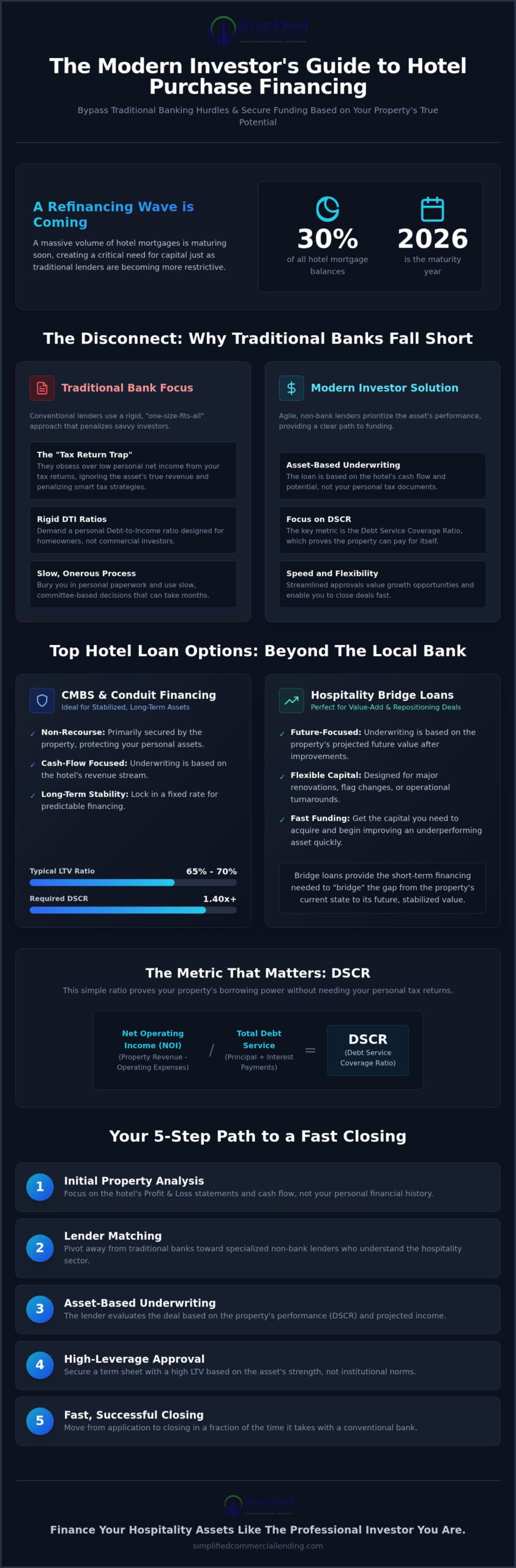
Did you know that 30% of all hotel mortgage balances are set to mature in 2026? This massive wave of refinancing is hitting just as traditional banks are tightening their grip on capital, leaving many investors stranded. You’ve likely felt the sting of their rigid requirements already. It’s exhausting to present a high-potential property only to have a loan officer obsess over your personal tax returns or a debt-to-income ratio that ignores the asset’s actual revenue. You need a partner who understands that a hotel is a business, not just a piece of real estate.
We agree that the old way of lending is broken for the modern entrepreneur. You shouldn’t be penalized for having a complex tax strategy that traditional institutions simply don’t understand. This guide is your roadmap to securing hotel purchase financing without the typical banking hurdles. You’ll discover how to leverage non-bank funding that prioritizes property cash flow over your personal financial history. We will show you how to move from application to a fast closing with high LTV ratios. It is time to stop acting like a residential borrower and start financing your hospitality assets like the professional investor you are.
Key Takeaways
- Learn why traditional banks often fail hospitality investors and how to pivot toward lenders who value property potential over personal tax returns.
- Explore specialized non-bank options for hotel purchase financing, including CMBS and bridge loans designed for stabilized or repositioned assets.
- Master the use of the Debt Service Coverage Ratio (DSCR) to prove your property’s borrowing power without digging through years of personal financial history.
- Follow a streamlined five-step process to move from initial property analysis to a fast, successful closing.
- Discover how to secure high-leverage funding by focusing on the hotel’s projected cash flow rather than rigid institutional norms.
Why Traditional Hotel Purchase Financing Often Hits a Wall
Traditional banks often treat a hotel acquisition like a standard residential mortgage. It’s a fundamental mismatch. They want to see pristine personal W-2s and a predictable income history that fits inside a narrow institutional box. But you’re an investor. Your income is complex. Your tax strategy is sophisticated. This disconnect is exactly why traditional hotel purchase financing often stalls before it even starts. Banks are looking at the wrong metrics, and it’s costing you opportunities.
The “Tax Return Trap” is the most frequent deal-killer in the hospitality sector. You likely use depreciation, interest deductions, and business expenses to legally minimize your taxable income. This is smart business. However, a traditional loan officer sees that low net income and immediately flags you as a risk. They ignore the actual cash flow of the hotel you’re buying. Instead, they focus on a piece of paper that doesn’t reflect your true financial strength or the asset’s potential.
The Problem with Conventional Bank Requirements
Conventional lenders operate with a “one size fits all” mentality. They typically demand three years of personal tax returns and require a debt-to-income (DTI) ratio that makes sense for a homeowner, not a commercial mogul. For an entrepreneur reinvesting capital into new ventures, this is an impossible standard to meet. These rigid requirements create several friction points:
- Onerous Documentation: Banks bury you in paperwork that has nothing to do with the property’s performance.
- Slow Approval Cycles: Committee-based decisions can take months, which is a lifetime in a competitive market.
- Ignoring Potential: Traditional underwriting rarely accounts for value-add opportunities or market growth.
These hurdles are even more pronounced in specialized hospitality segments. For instance, Condo Hotel Financial Considerations show how traditional banks struggle with mixed-use or rental-heavy assets. They simply don’t have the flexibility to underwrite based on projected occupancy or seasonal revenue shifts. They want certainty that their outdated models can’t provide.
Moving Toward Solution-Oriented Lending
In 2026, the commercial landscape has shifted toward more agile, non-bank alternatives. These lenders are the new standard for serious hospitality investors who need to move fast. They prioritize asset-based underwriting. This means they care about the hotel’s Debt Service Coverage Ratio (DSCR) rather than your personal credit card balance or last year’s tax write-offs.
This modern approach removes the bureaucratic bottlenecks that slow down your growth. You can secure high-leverage funding without exposing every detail of your personal life to a bank committee. By focusing on property potential, you can bypass the “Tax Return Trap” and scale your portfolio with confidence. It’s about finding a partner who values the numbers on the P&L statement over the numbers on your personal tax forms. You deserve a financing path that rewards your savvy as an investor instead of penalizing your success.
Top Hotel Loan Options: Beyond the Local Bank
Stop letting local banks dictate your growth with their narrow lending criteria. In 2026, the market for hotel purchase financing has expanded far beyond the traditional branch office. You have access to specialized vehicles designed for the unique rhythms of the hospitality industry. These options prioritize your asset’s performance and your vision as an operator, rather than just your personal credit score. Whether you are eyeing a stabilized luxury resort or a midscale property ripe for a turnaround, there is a specific capital source waiting to be tapped.
CMBS and Conduit Financing
CMBS (Commercial Mortgage-Backed Securities) loans are a powerhouse for investors seeking long-term stability. These are typically non-recourse, meaning the lender’s primary security is the property itself, not your personal assets. This structure protects your other investments if the market shifts. Conduit lenders focus heavily on the hotel’s cash flow, often requiring a Debt Service Coverage Ratio (DSCR) of 1.40x or higher for full-service properties. With LTVs typically ranging from 65% to 70%, CMBS is the gold standard for stabilized assets where you want to lock in a fixed rate and walk away with minimal personal liability.
Hospitality Bridge Loans for Value-Add Deals
Are you planning a major renovation or a “flag” change? A traditional bank will likely pass on a property that isn’t currently performing at its peak. This is where bridge loans shine. These short-term solutions offer up to 70% loan-to-cost (LTC), providing the capital needed for both the purchase and the improvements. The beauty of a bridge loan lies in its flexibility. You typically benefit from interest-only payments during the renovation phase. This preserves your cash flow while you reposition the asset. Once the property is stabilized and revenue climbs, you can transition into permanent financing with a much stronger valuation.
If you prefer government-backed options, the SBA hotel financing programs remain a viable path. Eligible borrowers can combine SBA 7(a) and 504 loans for up to $10 million in financing, often with LTVs as high as 90%. However, be prepared for significant red tape and longer closing times. For more complex deals, mezzanine debt can fill the gap between your primary mortgage and your equity, though these carry higher rates, often between 12% and 20%. If the paperwork of the SBA feels like a dead end, you can explore asset-based commercial property loans that move at the speed of your business. Choosing the right vehicle depends entirely on your hold period and the property’s current state of stabilization.
Asset-Based Underwriting: The Key to No-Doc Hotel Loans
Traditional banks obsess over your personal history. They want to see every pay stub, every personal debt, and every tax return from the last three years. We focus on the hotel’s performance. If the asset generates cash, it should qualify for a loan. This is the heart of no-doc hotel purchase financing. Your personal 1040s show where you’ve been; the property’s P&L shows where you’re going. A savvy investor knows that the property’s income is the most reliable metric for success.
Asset-based underwriting treats your hotel as a standalone business. It acknowledges that your personal tax strategy, which likely involves heavy depreciation and legal write-offs, shouldn’t be used against you. By prioritizing the asset’s revenue over your taxable income, lenders can provide capital to entrepreneurs who look “risky” to a standard bank but are actually highly successful. It’s a pragmatic approach that values results over protocol.
Decoding the DSCR in Hospitality
In the context of hotel purchase financing, the Debt Service Coverage Ratio (DSCR) is a financial metric that measures a property’s ability to cover its annual mortgage payments using its net operating income. Lenders use this ratio to determine your borrowing power. They look at Revenue Per Available Room (RevPAR), average occupancy, and total operating expenses to see if the hotel can comfortably support the debt.
To maximize your ratio, you must present a clean Profit and Loss statement. Focus on “add-backs.” These are non-cash expenses like depreciation or one-time capital expenditures that don’t affect daily cash flow but lower your net income on paper. Highlighting these items shows the lender the true earning potential of the property. A stronger DSCR doesn’t just get you an approval; it often unlocks more favorable terms and higher leverage.
The Freedom of No-Doc Financing
Do you want to scale your portfolio without revealing every detail of your personal financial life? No-doc loans provide that privacy. Since the underwriting focuses on the property, you can secure funding without the invasive deep dive into your personal background. This is a game-changer for high-growth investors who need to move quickly. In a competitive market, the ability to close fast can be the difference between winning a deal and losing it to a cash buyer.
For projects in less urban areas, USDA Business and Industry Loans offer another asset-focused path that prioritizes business viability and local economic impact. Whether you use a government-backed program or a private debt fund, the link between property equity and loan approval remains constant. When you have a strong asset and sufficient skin in the game, the bureaucratic hurdles of traditional banking simply disappear. You gain the freedom to scale as fast as your properties can perform.
5 Steps to Secure Your Hotel Purchase Financing Fast
Speed is the ultimate currency in the 2026 hospitality market. If you want to beat out the competition for a prime asset, you can’t afford to wait on a bank’s slow committee. You need a tactical roadmap to move from initial interest to a funded deal without the typical bureaucratic drag. Securing hotel purchase financing requires a proactive approach that prioritizes data and expert partnerships over standard paperwork.
Follow these five steps to streamline your path to ownership:
- Step 1: Conduct a thorough property analysis and P&L review.
- Step 2: Secure a signed Letter of Intent (LOI) to show sellers you’re serious.
- Step 3: Partner with a specialized commercial broker to source the right debt.
- Step 4: Navigate the appraisal and environmental review process with professional guidance.
- Step 5: Finalize the capital stack and move to a swift close.
Preparing Your Property Data
Lenders don’t just want to see that the hotel is open; they want to see how it competes. You must gather essential documents like Smith Travel Research (STR) reports and trailing 12-month (T12) P&Ls immediately. These documents provide the objective data needed to verify the property’s performance against its local “comp set.”
Accurate occupancy rates and Average Daily Rate (ADR) data are non-negotiable. They form the foundation of your cash flow narrative. If you can show a consistent upward trend in RevPAR (Revenue Per Available Room), you build a compelling case for the property’s future growth. This data allows your lender to look past your personal history and focus on the asset’s ability to service the debt.
The Power of a Commercial Broker
Working with a specialized broker opens doors to non-bank capital that you simply won’t find on your own. Brokers act as your navigator, translating your needs into a language that alternative lenders understand. They know how to bypass the “No” of traditional underwriters by structuring the deal around the property’s strengths rather than its weaknesses. This expertise saves you dozens of hours in negotiations and ensures you don’t get stuck in a dead-end application process.
A savvy navigator handles the heavy lifting of lender outreach, allowing you to focus on the operational side of the acquisition. If you are ready to skip the bank’s red tape and secure a faster close, you should apply for hotel purchase financing today to see how asset-based lending can work for you.
Finalizing the Deal
Once your data is solid and your lender is identified, you’ll move into the appraisal and environmental review phase. In the commercial world, a “Phase I” environmental report is standard. Don’t let these technical requirements intimidate you; they are simply checkboxes on the way to the closing table. By finalizing your capital stack early, you ensure that the transition of ownership is seamless and that your investment starts generating returns from day one.
Simplified Commercial Lending: Your Partner in Hotel Growth
Traditional banking feels like a series of interrogations. You provide your life’s history only to be told your “debt-to-income” ratio doesn’t fit a pre-set box. We’ve changed that. Simplified Commercial Lending acts as a bold innovator in the hospitality space. We don’t just process applications; we advocate for your success. Our team understands that hotel purchase financing should be based on the property’s ability to generate revenue, not your personal tax strategy.
We serve investors nationwide. Whether you’re acquiring a boutique stay on the coast or a midscale franchise in the heart of the country, our reach is absolute. We cut through the noise. We ignore the industry bottlenecks that leave other deals dead on arrival. By focusing on the asset’s value and its trailing twelve-month performance, we provide a path forward when the local bank says no.
Why Investors Choose Our Direct Approach
Speed is our signature. In a market where 30% of hotel mortgages are maturing in 2026, you need a partner who can move at the speed of business. We structure commercial property loans to provide maximum leverage and flexibility. You won’t find cold, detached language here. You’ll find a results-driven ally who prioritizes transparency. We tell you exactly what we need, and we deliver on our promises without the typical institutional stall tactics.
Our process is built for the independent entrepreneur. We know you’re busy managing operations and scouting new deals. You shouldn’t have to spend weeks explaining your depreciation schedule to a loan officer who doesn’t understand hospitality. Our underwriting is streamlined. It’s pragmatic. We look for reasons to say yes and help you bypass the hurdles that stop most investors in their tracks.
Ready to Scale Your Hospitality Assets?
Transitioning from a rejection at a traditional bank to a “Closed” status with us is simpler than you think. You can get a quote without the standard banking headache. We’ve removed the onerous tax return requirements that hold you back. Your property’s cash flow is your greatest asset; let us help you leverage it. We provide the capital you need to scale your portfolio without the invasive deep dive into your personal finances.
Don’t let rigid institutional norms slow your growth. The hospitality sector is evolving, and your financing should too. Take the first step toward a high-leverage, fast-closing deal. Get started with your hotel purchase financing today and experience a partnership that values your ambition. We are ready to help you secure the future of your hospitality investments.
Take Control of Your Hospitality Future
The days of begging big banks for approval are over. You’ve seen how asset-based underwriting and no-doc solutions can transform your acquisition strategy. By prioritizing property cash flow and Debt Service Coverage Ratios, you can bypass the “tax return trap” that stalls so many talented investors. You don’t need to fit into a rigid institutional box to scale your portfolio. Your success should be measured by the performance of your assets, not the complexity of your personal tax filings.
Whether you’re looking for long-term conduit debt or a flexible bridge loan, the right partner makes all the difference. Simplified Commercial Lending brings expertise in no-doc commercial lending and a deep commitment to speed. We provide nationwide service for hospitality investors who are ready to move fast. It’s time to stop acting like a residential borrower and start financing your growth like the professional you are. Our team is ready to act as your navigator through the 2026 lending landscape.
Secure your hotel purchase financing without the tax return headache. Your next property is waiting; let’s get it funded.
Frequently Asked Questions
Can I get hotel purchase financing without showing my personal tax returns?
Yes, you can secure hotel purchase financing without personal tax returns by choosing an asset-based or “no-doc” lender. These specialized programs prioritize the property’s Net Operating Income (NOI) and Debt Service Coverage Ratio (DSCR) over your personal 1040s. This approach is ideal for entrepreneurs who use legal deductions to minimize taxable income. It allows you to leverage the hotel’s revenue potential to qualify for capital while maintaining your financial privacy.
What is the typical down payment required for a hotel loan in 2026?
Typical down payments for hotel loans in 2026 range from 10% to 40% depending on the specific loan program. SBA 504 and 7(a) options offer the lowest requirements, often allowing for just 10% down. However, non-bank conduit or CMBS loans usually require 30% to 35% equity. If you are using a bridge loan for a turnaround project, expect to bring at least 30% of the total cost to the closing table to satisfy most lenders.
How does a DSCR loan work for a hotel purchase?
A DSCR loan evaluates the hotel’s ability to pay its own mortgage by comparing its annual net operating income to its annual debt obligations. For a hotel purchase, lenders typically look for a ratio between 1.25x and 1.40x. If the property generates $1.25 for every $1.00 of debt, it qualifies. This method empowers you to secure funding based on RevPAR and occupancy data instead of your personal debt-to-income ratio or employment history.
What is the difference between a hotel bridge loan and permanent financing?
A bridge loan is a short-term, interest-only solution used for renovations, brand changes, or stabilizing a property’s revenue. It is designed to “bridge” the gap until the asset is performing at its peak. Permanent financing, such as a CMBS or bank loan, provides long-term, fixed-rate debt for stabilized properties. Most investors use a bridge loan to reposition a hotel and then refinance into permanent debt once the property’s value has increased significantly.
Can I finance a hotel purchase if I don’t have prior hospitality experience?
You can finance a hotel without direct hospitality experience, but you will likely need a professional third-party management company in place. Lenders prioritize the operational success of the asset. If you don’t have a track record, hiring a management firm with a proven history satisfies their risk requirements. This allows you to act as the capital partner while experts handle the daily operations, making your loan application much more attractive to non-bank lenders.
What are the current LTV limits for commercial hotel loans?
Loan-to-value (LTV) limits vary by the source of capital and the property’s condition. In 2026, conventional bank loans average around 60% to 65% LTV. CMBS conduits offer slightly more leverage, typically reaching up to 70%. If you qualify for SBA programs, you can access up to 90% LTV. Bridge loans usually focus on loan-to-cost (LTC), often capping at 70% of the purchase and renovation budget. These limits ensure the lender has a protective equity cushion.
How long does it typically take to close a hotel purchase loan?
Closing times for hotel loans vary by lender type, but non-bank options are generally faster than traditional institutions. A bridge loan or asset-based commercial loan can often close within 30 to 45 days. In contrast, SBA loans or conventional bank financing can take 60 to 90 days due to extensive government red tape and committee reviews. Working with a specialized broker helps you streamline the process and meet tight acquisition deadlines in competitive markets.
Do hotel loans require a personal guarantee?
Not all hotel loans require a personal guarantee. CMBS and conduit loans are typically non-recourse, meaning the lender’s only recourse in a default is the property itself, not your personal assets. However, SBA loans and most conventional bank loans do require a full personal guarantee from anyone owning 20% or more of the business. Choosing a non-recourse option is a strategic way to protect your personal wealth while scaling a large hospitality portfolio.