The biggest name in the lending game isn’t always the best fit for your specific portfolio. If you’ve spent any time looking at CoreVest finance reviews, you know that while they’ve funded over 182,000 projects, massive scale doesn’t always mean a better experience for the individual investor. You’re likely tired of rigid institutional underwriting that feels more like an interrogation than a partnership. It’s frustrating to wait weeks for a decision only to face the anxiety of potential bait-and-switch terms at the closing table.
We believe your funding should empower your growth, not stall it. This article provides a transparent, broker-led evaluation of CoreVest’s current standing in 2026. You’ll gain a clear understanding of their reputation and how their direct lending model compares to the flexibility of a specialized brokerage. We’ll also map out a path to funding that prioritizes property cash flow over personal tax returns. By the end, you’ll know if CoreVest is the right fit or if a more agile, no-doc alternative is what you actually need to scale your investments.
Key Takeaways
- Analyze the institutional strength of CoreVest and what common corevest finance reviews reveal about their closing power for large-scale portfolios.
- Understand the fundamental differences between direct lenders and brokerages to ensure your financing partner doesn’t limit your options.
- Discover how to leverage no-doc and DSCR-based underwriting to secure funding based on property cash flow instead of personal tax returns.
- Identify common industry bottlenecks and learn how a resourceful ally can help you bypass long processing times and rigid underwriting.
- Evaluate your 2026 strategy to determine if your portfolio needs the massive scale of an institution or the specialized agility of a broker.
CoreVest Finance Reviews: What Real Estate Investors Need to Know
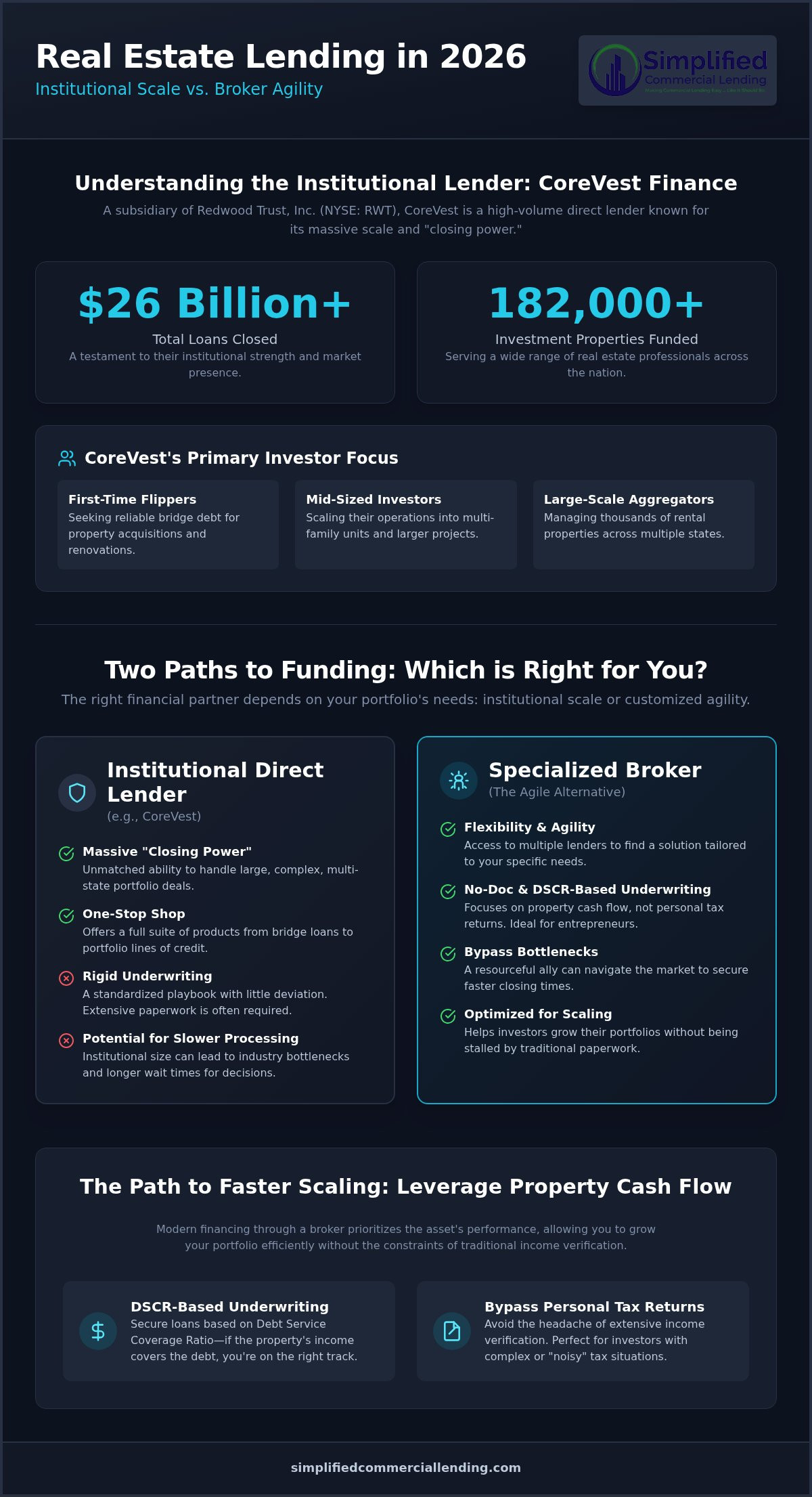
CoreVest Finance isn’t just another name in the directory. It’s a massive direct lender that has fundamentally changed how residential real estate investors access capital. Originally founded as Colony American Finance, the company is now a subsidiary of Redwood Trust, Inc. (NYSE: RWT). This corporate backing gives them deep pockets and a level of institutional stability that smaller shops simply can’t match. When you dig into corevest finance reviews, you’ll see they specialize in a specific lane: rental portfolios, bridge loans, and multi-family financing. They aren’t here for your primary residence. They’re here for your business.
Investors typically search for reviews to verify two things: closing speed and term reliability. Nobody wants to get to the one-week mark before closing only to have the interest rate move or the LTV drop. Because they handle everything from single-asset bridge loans to massive portfolio lines of credit, their reputation is built on being a “one-stop shop” for the professional real estate community.
The CoreVest Market Position in 2026
CoreVest operates as a high-volume institutional lender. By mid-2026, they’ve closed over $26 billion in loans and funded more than 182,000 projects. Their size is their biggest selling point for large-scale portfolio acquisitions. If you’re trying to roll twenty properties into a single line of credit, you need a lender with that kind of balance sheet. They serve a wide range of professionals, including:
- First-time flippers looking for reliable bridge debt.
- Mid-sized investors scaling into multi-family units.
- Massive rental aggregators managing thousands of doors across the country.
However, being a “big ship” means they have very specific rules about who gets on board. Their institutional nature provides security, but it often comes at the cost of the personalized flexibility that smaller, more agile investors crave.
Decoding the Review Sentiment
Reading corevest finance reviews in 2026 requires a discerning eye. You’ll often find a sharp divide in sentiment. Many investors praise their “closing power” and the ability to handle complex, multi-state deals that would choke a local bank. On the other side, you’ll see frustration regarding a rigid underwriting process. This is the trade-off of working with an institutional giant. They have a playbook, and they don’t deviate from it.
To get the most accurate picture, look for feedback specific to your loan type. A bridge loan review from two years ago might not reflect the efficiency of their 2026 rental portfolio products. Focus on the most recent data to see how their 30-day average closing time is holding up. If you’re an independent entrepreneur who needs a lender to look past a “noisy” tax return, the rigid institutional process mentioned in many reviews might be your biggest hurdle.
Evaluating CoreVest’s Loan Products and Terms
CoreVest doesn’t build products for the casual landlord with a single duplex. They design debt solutions for real estate professionals who treat their portfolio like a business. If you’ve spent time reading corevest finance reviews, you’ll see a recurring theme: their strength lies in their ability to aggregate properties under a single loan umbrella. They offer a full suite of debt products, including rental portfolio loans for five or more properties, bridge loans for stabilization, and multi-family financing for buildings with five or more units.
Their model is built on institutional reliability. However, this scale often comes with a trade-off in flexibility. While they focus on the asset’s performance, the paperwork required to satisfy an institutional lender can be extensive. Investors who need to move quickly without digging through years of tax returns often find the process more rigid than they anticipated.
Rental and Portfolio Lines of Credit
How do you tap into the equity of ten different houses to buy your eleventh? CoreVest uses portfolio lines of credit to help investors consolidate debt and unlock capital. Their underwriting focuses heavily on the Debt Service Coverage Ratio (DSCR), but don’t mistake “asset-based” for “no-doc.” As a subsidiary of a major public entity, their compliance standards are high. If your goal is to grow without the headache of traditional income verification, you might find more agility with a portfolio line of credit for rentals that prioritizes property cash flow over your personal 1040s.
Bridge and Construction Loans
Speed is the primary currency for value-add projects. In the 2026 market, CoreVest’s bridge loans offer short-term capital with terms ranging from 6 to 24 months. For fix-and-flip projects, investors can expect leverage around 70% LTV, with interest rates hovering near 8% for qualified borrowers. They also offer up to 85% LTC for bridge debt, providing significant leverage for those who know how to stabilize a property quickly.
The real value of their bridge product is the built-in path to permanent financing. Once a project is stabilized, CoreVest aims to transition the borrower into a long-term rental loan. It’s a streamlined concept, but the execution depends on your ability to meet their specific institutional criteria at every stage. If you’re worried about getting stuck in a bridge loan because of shifting underwriting rules, it’s worth exploring how a specialized broker can provide multiple exit strategies from the start. We navigate the bottlenecks so you can focus on the next acquisition.
Common Praise and Pain Points in CoreVest Reviews
Analyzing corevest finance reviews in 2026 reveals a clear pattern: your experience depends entirely on the size of your deal. Positive feedback frequently highlights their ability to handle large, complex transactions that would overwhelm a local bank. Repeat borrowers often praise the lender’s “closing power.” When you need to move millions of dollars into a new acquisition, you need that institutional weight behind you. They provide a level of reliability that gives professional investors confidence during the due diligence phase.
However, the feedback isn’t universally positive. Many independent investors report frustration with “last-minute” changes to terms. These pain points often center on rigid document requests that appear late in the process. Communication delays are another common theme, particularly for smaller, single-asset borrowers. If you’re only financing one or two units, you might feel like a small fish in a very large pond. This is the reality of working with a high-volume direct lender; they prioritize the largest deals on their desk.
Why Institutional Lenders Can Feel Rigid
Working with a direct lender often feels like dealing with a “Black Box” of underwriting. You submit your documents and wait for a decision that comes from a committee you’ll never meet. Personalized service often takes a backseat to institutional protocol. Even when a lender claims to focus on the asset, personal tax returns can still become a major sticking point. This is where the process differs from no doc rental property loans, which prioritize the property’s cash flow over your personal income history to keep the momentum of your scale. When the rulebook is written for massive aggregators, the independent entrepreneur often gets squeezed by requirements that don’t fit their business model.
Addressing the “Bait and Switch” Concerns
One of the most frequent complaints in corevest finance reviews involves shifting term sheets. It’s important to understand that a term sheet is not a binding contract. It’s an estimate based on your initial application. Terms often change during the due diligence phase because of the property appraisal. If the appraiser’s value comes in lower than expected, the lender will adjust the final loan-to-value (LTV) ratio to manage their risk. This feels like a bait-and-switch to the borrower, but it’s usually a byproduct of institutional risk management.
Protect yourself by having a backup financing plan ready. Don’t put all your eggs in one institutional basket. If the appraisal comes back light or the underwriting team adds new conditions at the eleventh hour, you need the ability to pivot. A specialized broker can often act as your advocate here, providing a safety net if the direct lender’s process stalls or the terms no longer align with your goals.
CoreVest vs. The Broker Model: Which Path Scales Faster?
Direct lenders like CoreVest provide a single path to capital. It’s their money and their rules. If your portfolio fits their specific 2026 underwriting criteria, the process moves forward. If it doesn’t, you’re out of luck. This “one-size-fits-all” approach is a frequent catalyst for negative corevest finance reviews. In contrast, a broker acts as a strategic navigator. We don’t just offer one product; we open doors to an entire market of institutional and private funding sources. You aren’t auditioning for a lender. We’re making lenders compete for your business.
The Advantage of Multiple Funding Sources
Lender appetites shift constantly. A direct lender might love multi-family deals in January but pull back by June. If you’re tied to them, your growth stalls. A broker prevents you from getting stuck. We act as your advocate, pivoting to a different source if your primary option changes their terms. This flexibility allows you to explore commercial property loan options that go far beyond the standard big-box menu. We manage the search, handle the initial vetting, and present you with the best available terms. It’s about having a safety net that ensures your deal closes, regardless of one institution’s internal policy changes.
Documentation: No-Doc vs. Institutional Requirements
The “paperwork fatigue” mentioned in many corevest finance reviews is real. Institutional lenders often require years of personal tax returns and exhaustive financial disclosures. Simplified Commercial Lending takes a different path. We focus on the property’s cash flow through Debt Service Coverage Ratio (DSCR) underwriting. We don’t need to see your personal 1040s to know if a rental deal makes sense. This is the fundamental difference between a lender that looks at you and a broker that looks at the deal.
Scaling without tax returns is the ultimate goal for the independent entrepreneur. It removes the bureaucratic hurdles that slow down your momentum. By prioritizing the asset over the individual, we streamline the entire funding journey. You get the capital you need without the invasive documentation requests that define traditional banking. This approach eliminates the anxiety of being judged on your personal income rather than your investment savvy. If you’re ready to bypass the institutional bottlenecks and scale with speed, partner with a broker who prioritizes your agility and get your next project funded now.
Finding the Right Capital Partner for Your 2026 Strategy
Choosing a capital partner is the most consequential decision you’ll make for your portfolio this year. It’s not just about the interest rate. It’s about the speed of execution and the reliability of the relationship. If your 2026 strategy involves aggressive acquisition, you need a lender that matches your pace. Big-box institutions serve a purpose, but they often struggle with the nuanced needs of independent entrepreneurs. You need a “Simplified” approach that clears the path instead of cluttering it with red tape. Successful scaling requires a partner that aligns with your specific portfolio size and understands your long-term goals.
Scaling Your Rental Portfolio
Cash flow is the primary engine of 2026 growth. By mastering dscr loan requirements, you can leverage the income of the property itself to secure funding. This is a game-changer for those scaling into multi-family units or short-term rentals. Many traditional lenders ignore the full potential of Airbnb or VRBO income. A savvy partner uses that actual cash flow to justify higher LTVs. It is about looking at the future revenue of the asset rather than your personal income history. This cash-flow based lending is the key to maintaining momentum without hitting the “debt-to-income” wall that stops most investors in their tracks.
Take the Next Step with Simplified Commercial Lending
Don’t let your momentum die in an institutional underwriting queue. If the recurring complaints in corevest finance reviews about rigid document requests and long processing times sound familiar, it’s time for a change. Simplified Commercial Lending removes the institutional friction. We specialize in no-doc commercial and rental loans for single-family, multi-family, and portfolio lines of credit nationwide. We bypass the “Black Box” of committee-led decisions to provide immediate, actionable resolutions for your funding needs.
Our process is built for speed. We prioritize property performance over personal tax returns. This allows you to skip the invasive documentation and get straight to the closing table. Whether you’re refinancing a stabilized asset or funding a new acquisition, we provide the agility you need to win in a competitive market. Skip the institutional headache. Get a tailored solution that actually fits your portfolio size and your ambition. Apply today to see how we simplify your path to closing and help you scale your 2026 portfolio with confidence.
Master Your Portfolio Growth in 2026
You’ve seen what corevest finance reviews highlight: institutional power often comes with institutional red tape. While massive lenders offer stability for the largest aggregators, independent investors often need a more agile partner. The choice between a direct lender and a broker model isn’t just about rates. It’s about who will fight to bypass the bureaucratic bottlenecks that stall your momentum.
Simplified Commercial Lending specializes in no-doc and DSCR-based underwriting. We provide national coverage for all investment property types, ensuring you aren’t limited by one lender’s changing appetite. We empower you to focus on property cash flow rather than digging through years of personal financial history. Your ambition shouldn’t be capped by a rigid underwriting committee. Take control of your funding and keep your projects moving forward.
Frequently Asked Questions
Is CoreVest Finance a direct lender or a broker?
CoreVest Finance is a direct lender that funds loans using its own institutional capital. As a subsidiary of Redwood Trust, Inc., they operate with a massive balance sheet rather than acting as a middleman. This allows them to offer large scale portfolio lines of credit and residential investment loans directly to professional investors. While they provide significant closing power, they are strictly limited to their own internal underwriting rules and product menus.
What is the minimum loan amount for CoreVest Finance?
CoreVest typically requires a minimum loan amount of $75,000 for their bridge products. For rental portfolio loans, the threshold is often higher because these products are designed for five or more properties. They focus on professional investors scaling significant portfolios rather than single property beginners. If your deal falls below their minimum requirements, you may need to look toward a more flexible brokerage that has access to a wider variety of private funding sources.
Does CoreVest Finance require tax returns for rental loans?
CoreVest often requires tax returns and deep financial documentation because of their institutional underwriting standards. While they focus on property cash flow, their status as a public company subsidiary necessitates rigorous compliance. Many corevest finance reviews mention frustration with these extensive document requests. If you want to scale without the paperwork fatigue, a no-doc broker like Simplified Commercial Lending can secure funding based solely on Debt Service Coverage Ratio (DSCR) without ever asking for your tax returns.
How long does it typically take to close a loan with CoreVest?
The typical closing timeframe with CoreVest is approximately 30 days from application to funding. Some products, such as their bridge loans, can close in as little as one week for experienced borrowers with straightforward deals. However, complex portfolio loans involving multiple properties often take longer to clear the institutional underwriting process. Speed is a major factor in 2026 real estate transactions, so it is essential to have all your property documentation ready before you start the process.
What are the most common complaints in CoreVest Finance reviews?
The most common complaints found in corevest finance reviews center on a rigid underwriting process and last minute changes to term sheets. Borrowers often express frustration when loan to value ratios are adjusted late in the process due to appraisal values. Additionally, smaller investors occasionally report communication delays, as the firm’s institutional model tends to prioritize high volume portfolio deals. These bottlenecks are a primary reason why many independent entrepreneurs prefer the personalized advocacy provided by a specialized broker.
Can I get a DSCR loan for an Airbnb with CoreVest?
Yes, CoreVest provides short term rental financing for properties listed on platforms like Airbnb and VRBO. They use Debt Service Coverage Ratio underwriting to evaluate the property’s income potential. However, institutional lenders can be conservative with short term rental income projections. If you are looking to maximize your leverage on a high performing vacation rental, working with a broker who understands the nuances of the 2026 rental market can help you access more aggressive options.
Are CoreVest rates competitive for 2026?
CoreVest rates remain competitive for the institutional market, with bridge loans recently hovering around 8% for qualified borrowers. Their rental portfolio rates are typically lower than bridge debt but vary based on the total loan amount and portfolio size. While their rates are strong, the total cost of capital includes origination fees, which can reach 2.5%. Always compare the total all in cost of an institutional loan against the speed and flexibility offered by alternative private credit sources.
What is the alternative to CoreVest for no-doc commercial loans?
The primary alternative for investors seeking a more agile experience is a specialized broker like Simplified Commercial Lending. We offer a true no-doc approach that bypasses the rigid institutional requirements found in the traditional banking sector. By focusing exclusively on property cash flow and DSCR, we enable national investors to fund single family, multi family, and commercial assets without personal tax returns. This model provides the flexibility to navigate shifting market appetites that single direct lenders cannot match.